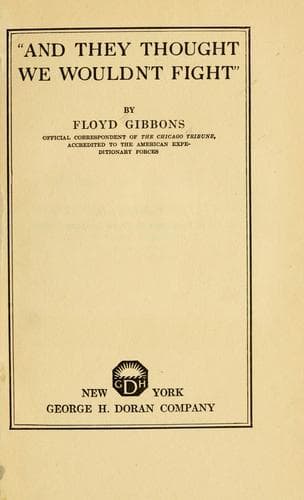
"And they thought we wouldn't fight"Gibbons, Floyd Phillips
History
"And they thought we wouldn't fight"
Gibbons, Floyd Phillips
World War, 1914-1918 -- Campaigns -- Western Front; World War, 1914-1918 -- Personal narratives
In New York, I sought passage on the first American ship sailing for
England. I made the rounds of the steamship offices and learned that the
Cunard liner _Laconia_ was the first available boat and was about to
sail. She carried a large cargo of munitions and other materials of war.
I booked passage aboard her. It was on Saturday, February 17th, 1917,
that we steamed away from the dock at New York and moved slowly down the
East River. We were bound for Liverpool, England. My cabin accommodations
were good. The _Laconia_ was listed at 18,000 tons and was one of the
largest Cunarders in the Atlantic service. The next morning we were out
of sight of land.
Sailors were stationed along the decks of the ship and in the look-outs
at the mast heads. They maintained a watch over the surface of the sea
in all directions. On the stern of the ship, there was mounted a
six-inch cannon and a crew of gunners stood by it night and day.
Submarines had been recently reported in the waters through which we
were sailing, but we saw none of them and apparently they saw none of
us. They had sunk many ships, but all of the sinkings had been in the
day time. Consequently, there was a feeling of greater safety at night.
The _Laconia_ sailed on a constantly zig-zagging course. All of our
life-boats were swinging out over the side of the ship, so that if we
were hit they could be lowered in a hurry. Every other day the
passengers and the crew would be called up on the decks to stand by the
life-boats that had been assigned to them.
The officers of the ship instructed us in the life-boat drill. They
showed us how to strap the life-preservers about our bodies; they showed
us how to seat ourselves in the life-boats; they showed us a small keg
of water and some tin cans of biscuits, a lantern and some flares that
were stored in the boat, and so we sailed along day after day without
meeting any danger. At night, all of the lights were put out and the
ship slipped along through the darkness.
On Sunday, after we had been sailing for eight days, we entered the zone
that had been prohibited by the Kaiser. We sailed into it full steam
ahead and nothing happened. That day was February the twenty-fifth. In
the afternoon, I was seated in the lounge with two friends. One was an
American whose name was Kirby; the other was a Canadian and his name was
Dugan. The latter was an aviator in the British army. In fights with
German aeroplanes high over the Western Front he had been wounded and
brought down twice and the army had sent him to his home in Canada to
get well. He was returning once more to the battle front "to stop
another bullet," as he said.
As we talked, I passed around my cigarette case and Dugan held a lighted
match while the three of us lighted our cigarettes from it. As Dugan
blew out the match and placed the burnt end in an ash tray, he laughed
and said,
Public-domain text, read in full here on John Shaqi.
Reviews
Reviews
No reviews yet
Be the first to share your thoughts on this work.
Join the Discussion
Join the discussion
Sign in to leave a comment or review.
Sign InorCreate an account