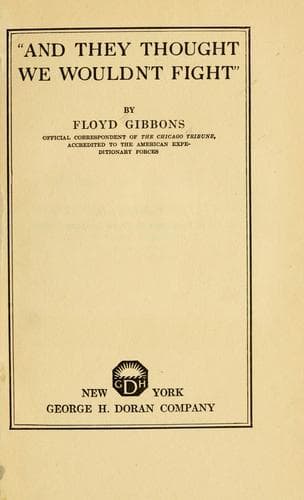
"And they thought we wouldn't fight"Gibbons, Floyd Phillips
History
"And they thought we wouldn't fight"
Gibbons, Floyd Phillips
World War, 1914-1918 -- Campaigns -- Western Front; World War, 1914-1918 -- Personal narratives
Where the stream left the gaping ruins of a stone house on the edge of
the village, there was a well-kept French graveyard, clinging to the
slope of a small hill. Above the ruins of the hamlet, stood the steeple
of the old stone church, from which it was customary to ring the alarm
when the Germans sent over their shells of poison gas.
Our officers busied themselves with, unfinished supply problems. Such
matters as rubber boots for the men, duck boards for the trenches, food
for the mules, and ration containers necessary for the conveyance of hot
food to the front lines, were not permitted to interfere with the
battalion's movements. In war, there is always the alternative of doing
without or doing with makeshifts, and that particular battalion
commander, after three years of war, was the kind of a soldier who made
the best of circumstances no matter how adverse they may have been.
That commander was Major Griffiths. He was an American fighting man. His
military record began in the Philippine Insurrection, when, as a
sergeant in a Tennessee regiment of National Guard, he was mentioned in
orders for conspicuous gallantry. At the suppression of the
insurrection, he became a major in the United States Constabulary in the
Philippines. He resigned his majority in 1914, entered the Australian
forces, and was wounded with them in the bloody landing at Gallipoli. He
was invalided to England, where, upon his partial recovery, he was
promoted to major in the British forces and was sent to France in
command of a battalion of the Sherwood Foresters. With them, he received
two more wounds, one at the Battle of Ypres, and another during the
fighting around Loos.
He was in an English hospital when America entered the war, but he
hurried his convalescence and obtained a transfer back to the army of
his own country. He hadn't regained as yet the full use of his right
hand, his face still retained a hospital pallor, and an X-ray photograph
of his body revealed the presence of numerous pieces of shell still
lodged there. But on that night of January 21st, he could not conceal
the pride that he felt in the honour in having been the one chosen to
command the battalion of Americans that was to take over the first
American sector in France. Major Griffiths survived those strenuous days
on the Pont-a-Mousson front, but he received a fatal wound three months
later at the head of his battalion in front of Catigny, in Picardy. He
died fighting under his own flag.
Just before daylight failed that wintry day, three poilus walked down
the road from the front and into Ansauville. Two of them were helping a
third, whose bandaged arm and shoulder explained the mission of the
party. As they passed the rolling kitchens where the Americans were
receiving their last meal before entering the trenches, there was
silence and not even an exchange of greetings or smiles.
Public-domain text, read in full here on John Shaqi.
Reviews
Reviews
No reviews yet
Be the first to share your thoughts on this work.
Elsewhere in the archive
Join the Discussion
Join the discussion
Sign in to leave a comment or review.
Sign InorCreate an account