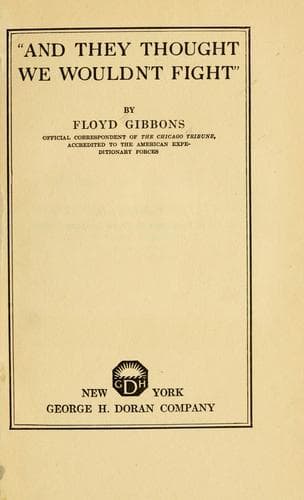
"And they thought we wouldn't fight"Gibbons, Floyd Phillips
History
"And they thought we wouldn't fight"
Gibbons, Floyd Phillips
World War, 1914-1918 -- Campaigns -- Western Front; World War, 1914-1918 -- Personal narratives
Under this seemingly eternal espionage punctuated at intervals by heavy
shelling, several old women of the village had remained in their homes,
living above the ground on quiet days and moving their knitting to the
front yard dugout at times when gas and shell and bomb interfered. Some
of these women operated small shops in the front rooms of their damaged
homes and the Americans lined up in front of the window counters and
exchanged dirty French paper money for canned _pate de foi gras_ or jars
of mustard.
A machine gun company with mule-drawn carts led the movement from
Ansauville into the front. It was followed at fifty yard intervals by
other sections. Progress down that road was executed in small groups--it
was better to lose one whole section than an entire company.
That highroad to the front, with its border of shell-withered trees, was
revealed that night against a bluish grey horizon occasionally rimmed
with red. Against the sky, the moving groups were defined as impersonal
black blocks. Young lieutenants marched ahead of each platoon. In the
hazy light, it was difficult to distinguish them. The only difference
was that their hips seemed bulkier from the heavy sacks, field glasses,
map cases, canteens, pistol holsters and cartridge clips.
Each section, as it marched out of the village, passed under the eye of
Major Griffiths, who sat on his horse in the black shadow of a wall. A
sergeant commanding one section was coming toward him.
"Halt!" ordered the Major. "Sergeant, where is your helmet?"
"One of the men in my section is wearing it, sir," replied the Sergeant.
"Why?" snapped the Major.
"Somebody took his and he hadn't any," said the Sergeant, "so I made him
wear mine, sir."
"Get it back and wear it yourself," the Major ordered. "Nothing could
hurt the head of a man who couldn't hang on to his own helmet."
The order was obeyed, the section marched on and a bareheaded Irishman
out of hearing of the Major said, "I told the Sergeant not to make me
wear it; I don't need the damn thing."
Another section passed forward, the moonlight gleaming on the helmets
jauntily cocked over one ear and casting black shadows over the faces of
the wearers. From these shadows glowed red dots of fire.
"Drop those cigarettes," came the command from the all watchful, unseen
presence mounted on the horse in the shadow of the wall. Automatically,
the section spouted red arcs that fell to the road on either side in a
shower of sparks.
"It's a damn shame to do that." Major Griffith spoke to me standing
beside his horse. "You can't see a cigarette light fifty yards away, but
if there were no orders against smoking, the men would be lighting
matches or dumping pipes, and such flashes can be seen."
Public-domain text, read in full here on John Shaqi.
Reviews
Reviews
No reviews yet
Be the first to share your thoughts on this work.
Elsewhere in the archive
Join the Discussion
Join the discussion
Sign in to leave a comment or review.
Sign InorCreate an account