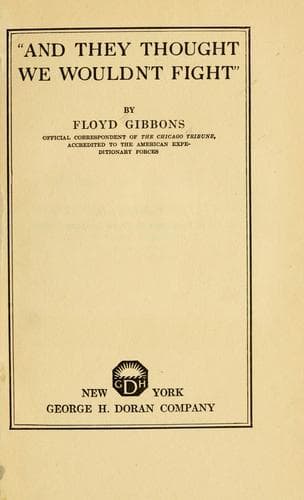
"And they thought we wouldn't fight"Gibbons, Floyd Phillips
History
"And they thought we wouldn't fight"
Gibbons, Floyd Phillips
World War, 1914-1918 -- Campaigns -- Western Front; World War, 1914-1918 -- Personal narratives
There was need for caution. The enemy was always watchful for an
interval when one organisation was relieving another on the line. That
period represented the time when an attack could cause the greatest
confusion in the ranks of the defenders. But that night our men
accomplished the relief of the French Moroccan division then in the line
without incident.
* * * * *
Two nights later, in company with a party of correspondents, I paid a
midnight visit to our men in the front line trenches of that first
American sector. With all lights out, cigarettes tabooed and the siren
silenced, our overloaded motor slushed slowly along the shell-pitted
roads, carefully skirting groups of marching men and lumbering supply
wagons that took shape suddenly out of the mist-laden road in front of
us.
Although it was not raining, moisture seemed to drip from everything,
and vapours from the ground, mixing with the fog overhead, almost
obscured the hard-working moon.
In the greyness of the night sight and smell lost their keenness, and
familiar objects assumed unnatural forms, grotesque and indistinct.
From somewhere ahead dull, muffled thumps in the mist brought memories
of spring house cleaning and the dusting out of old cushions, but it was
really the three-year-old song of the guns. Nature had censored
observation by covering the spectacle with the mantle of indefiniteness.
Still this was the big thing we had come to see--night work in and
behind the front lines of the American sector.
We approached an engineers' dump, where the phantoms of fog gradually
materialised into helmeted khaki figures that moved in mud knee-deep and
carried boxes and planks and bundles of tools. Total silence covered all
the activity and not a ray of light revealed what mysteries had been
worked here in surroundings that seemed no part of this world.
An irregular pile of rock loomed grey and sinister before us, and,
looking upward, we judged, from its gaping walls, that it was the
remains of a church steeple. It was the dominating ruin in the town of
Beaumont.
"Turn here to the left," the officer conducting our party whispered into
the ear of the driver.
The sudden execution of the command caused the officer's helmet to rasp
against that of the driver with a sound that set the cautious whispering
to naught.
"Park here in the shadow," he continued. "Make no noise; show no light.
They dropped shells here ten minutes ago. Gentlemen, this is regimental
headquarters. Follow me."
In a well buttressed cellar, surmounted by a pile of ruins, we found the
colonel sitting at a wooden table in front of a grandfather's clock of
scratched mahogany. He called the roll--five special correspondents,
Captain Chandler, American press officer, with a goatee and fur coat to
match; Captain Vielcastel, a French press officer, who is a marquis and
speaks English, and a lieutenant from brigade headquarters, who already
had been named "Whispering Willie."
Public-domain text, read in full here on John Shaqi.
Reviews
Reviews
No reviews yet
Be the first to share your thoughts on this work.
Elsewhere in the archive
Join the Discussion
Join the discussion
Sign in to leave a comment or review.
Sign InorCreate an account