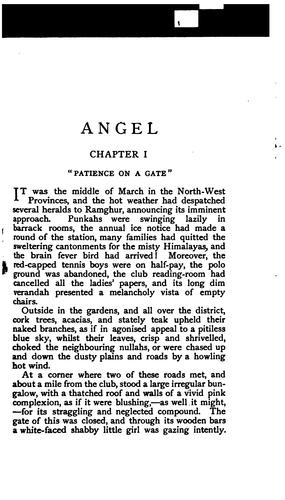
Angel: A sketch in Indian inkCroker, B. M. (Bithia Mary)
History
Angel: A sketch in Indian ink
Croker, B. M. (Bithia Mary)
British -- India -- Fiction; India -- History -- British occupation, 1765-1947 -- Fiction
Philip was entirely engrossed in his work. He had developed into an
official of importance. His life seemed to belong not to himself,
much less to her, but to the Imperial Government; telegraph peons,
mounted orderlies, and busy messengers crowded round his office, and
it was often seven o'clock in the evening when he appeared in her
sitting-room, looking utterly weary and fagged. Nevertheless she was
bound to confess that he never forgot to ask her how she had spent the
day? who had been to see her? whom she had been to see? how she had
amused herself? This was her _rôle_; she was to play, whilst he worked.
Then when they went out to dinners he scarcely glanced at her dress,
and, of course, during the evening she never exchanged a word with him.
Little did his partners guess how his wife envied them! Clever men and
clever women absorbed all her husband's attention as their right—and
she was deserted.
Philip never appeared to realise that she looked for anything beyond
a pretty home, pretty frocks, horses and dogs, flowers and books, and
a running stream of amusement. He was thoughtful of her health and
comfort, most particular in the choice of her servants and horses, and
then, having loaded her with luxuries, he withdrew into his work, and
it never seemed to occur to him that her life lacked anything, least of
all his own companionship. Angel was proud, and she kept her sorrow to
herself. Only on one occasion her feelings had broken their prison, and
she had thrown out a hint to Mrs. Gordon, who promptly said:
"Where, oh Princess, is the crumpled roseleaf? What is your desire?
What do you lack?"
"Love."
"My dear Angel!" she ejaculated.
"Yes—I've never had enough," she answered. "I feel something always
starving and crying in my heart," she answered with a slight sob, and
eyes full of tears.
"You silly, sentimental goose!" cried Mrs. Gordon. "You mean the sort
of stuff one reads about in poetry, that flames and flares up, and goes
out like a fire of straw?"
"No," rejoined the girl in a tone of repressed passion, "but a love
that cannot endure separation—that turns away from everything in the
world to you—that thinks of you—dreams of you—cannot live without
you—and would die for you."
"My goodness, Angel!" exclaimed her friend, aghast; "but," she went
on reflectively, "I believe I understand what you mean, though I have
never experienced it myself, and"—with a short sigh—"never shall. I
am thirty-six years of age, and I shall go to my grave never having
seen what you speak of. The love you dream of is rare—it never came
into _my_ life."
"And what do you accept instead?" asked the girl sharply.
"Oh—community of interests—mutual forbearance and respect."
"Which means that you forbear—and all the world respects," broke in
the old impulsive Angel. "Oh, Elinor," startled at her companion's
face, "forgive me."
"Certainly, my dear; but of what have you to complain?"
Public-domain text, read in full here on John Shaqi.
Reviews
Reviews
No reviews yet
Be the first to share your thoughts on this work.
Elsewhere in the archive
Join the Discussion
Join the discussion
Sign in to leave a comment or review.
Sign InorCreate an account