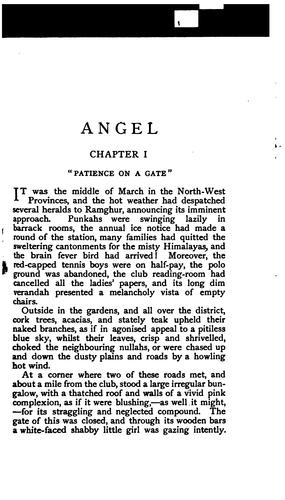
Angel: A sketch in Indian inkCroker, B. M. (Bithia Mary)
History
Angel: A sketch in Indian ink
Croker, B. M. (Bithia Mary)
British -- India -- Fiction; India -- History -- British occupation, 1765-1947 -- Fiction
BEFORE continuing this history, it is necessary to say a few words
respecting Lola Waldershare. As Lola Hargreaves, ever lovely,
seductive, and smiling, by strangers and mere acquaintances, she was
looked upon as one of the most bewitching girls in the county. Her
beauty, youthful graces, and charm, threw a dazzling glamour over her
personality that her immediate surroundings were not blinded to her
faults; her brothers recognised her selfishness; her mother was aware
that her heart was hard as a nether millstone. Those who had little
dealings with Miss Hargreaves learnt that she was not particularly
truthful or scrupulous. The increasing straitness of the family
fortunes, the struggle to make a brave display abroad, the shifts,
shabbiness, and pinching, at home, the manœuvres to evade creditors,
and keep up appearances, had left their mark on Lola. Poverty was
hideous; humiliation was unendurable; and Lola was resolved to be rich.
A short season in London had shown her the value of her beauty; her
face was, and should be, her fortune; and long before Philip Gascoigne
had any idea of his fate, he had been mentally discarded by his
_fiancée_. Letters are deceptive, it is so much easier to deceive by
pen and ink than by word of mouth. What Mrs. Danvers had declared was
perfectly true; Lola had sacrificed herself—for herself. In marrying
Reuben Waldershare she attained her wishes—though she would have
been glad to eliminate two well-grown step-sons—and Mr. Waldershare,
for his part, was well satisfied with his bargain. Unfortunately, in
an evil moment he took his beautiful young wife to Monte Carlo, and
there the Hargreaves' demon, the gambling demon, awoke, and seized upon
her. The taint was in her blood; Lola was her father's own daughter.
At first she was contented to win small sums at roulette, which she
gleefully invested in hats and lace and trifling ornaments. After
a week, as the poison began to work, she increased her stakes, and
talked fluently of "douzaines" and "transversals" and "runs." She
relinquished expeditions to Nice, or into Italy. She grudged every
hour spent elsewhere than at the rooms. She had her own lucky table,
her lucky charm, and, above all, her system. Like most beginners, she
won largely, and Reuben Waldershare, who was obtrusively proud of his
clever, elegantly dressed, smart wife, liked to see people crane over
in order to watch her pretty eager face, as she sat with rolls of gold
rouleaux before her, her pencil busy, her eyes ablaze.
Little did he know that he had fired a mine the day he placed three
hundred pounds to his wife's account at the Credit Lyonnaise, and told
her half in joke, that was "a little sum to play with."
Mrs. Waldershare now played incessantly—and played high.
"I like to put a 'mile' note on one number," she declared with a gay
laugh; "I agree with an old man who sat next me, 'Ca vous donne des
emotions.'"
Public-domain text, read in full here on John Shaqi.
Reviews
Reviews
No reviews yet
Be the first to share your thoughts on this work.
Elsewhere in the archive
Join the Discussion
Join the discussion
Sign in to leave a comment or review.
Sign InorCreate an account