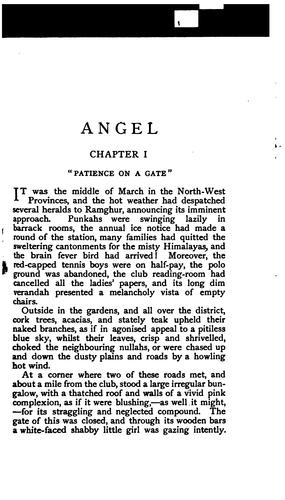
Angel: A sketch in Indian inkCroker, B. M. (Bithia Mary)
History
Angel: A sketch in Indian ink
Croker, B. M. (Bithia Mary)
British -- India -- Fiction; India -- History -- British occupation, 1765-1947 -- Fiction
"No, no, my dear fellow," rejoined Gascoigne with a laugh, and a
significant glance at Mrs. Waldershare. "How could the ladies spare
you?"
In two days' time Colonel Gascoigne had left home, and Angel for once
was not disconsolate. She analysed her feelings, dug down deeply into
her motives, and the sensation she there discovered was not sorrow, but
relief. She had been dimly aware of a vague uneasiness, an intangible
dread of developments. All this was at an end now.
CHAPTER XXXVI
JOINT HOSTESS
AND thus Mrs. Waldershare was established as Mrs. Gascoigne's chaperone
and companion; and the station, who considered it a most excellent
arrangement, and but yet another proof of her husband's good sense,
cried Wah! wah! They had been duly informed of the ancient friendship
which had existed between his parents and Mrs. Waldershare's. There
was no mention of a love affair—crafty Lola had set back the intimacy
a whole generation—it was discreetly cloaked in the mantle of years.
Mrs. Nobbs, who acted as spokeswoman for Mrs. Grundy, eagerly assured
every one she met that she highly approved of the move. It was most
unbecoming (favourite word) for a young married woman to be left
alone, and Mrs. Waldershare was such a quiet, sensible, charming
chaperone,—and so clever. Truly she was marvellously clever; in some
gradual, inexplicable fashion, she assumed the lead of the household.
Yes, without sound, or beat of drum. She was joint hostess, not guest;
there was a solid, resistless force in her character that Angel was
powerless to combat. At early morning, or afternoon tea, it was no
uncommon thing for her to find Mrs. Waldershare already seated before
the teapot. This position carries a certain status with it, and
Lola's visitors went so far as to assume from the air of nonchalant
hospitality with which she offered cream and cakes, that she was
"sharing expenses."
This was precisely how she wished it to be understood. To Angel, a
sort of guest at her own table, she offered playful apologies, and
assurances that "she was the best tea maker in England, and liked to
save her dear child trouble."
But there was one lady who regarded the new _ménage_ with the gravest
misgivings, and this was Mrs. Gordon, who, before departing to the
hills, had confided her fears to Padre Eliot.
"I do not trust Mrs. Waldershare," she said.
"Why not?" he asked, "she is quiet, and handsome, and ladylike."
"She is a clever, crafty woman, not too scrupulous in money matters. I
believe"—lowering her voice—"that she gambles! Of course, I have no
business to have prejudices and to hear gossip."
"It is not like you, certainly," he said, with his broad smile. "I
believe there has been gambling in the station somewhere, recently; one
or two boys have been hard hit,—but why suspect a lady?"
"It is more than suspicion. How I wish Colonel Gascoigne had not left
Angel with that woman. It is like leaving a lamb to a wolf."
Public-domain text, read in full here on John Shaqi.
Reviews
Reviews
No reviews yet
Be the first to share your thoughts on this work.
Elsewhere in the archive
Join the Discussion
Join the discussion
Sign in to leave a comment or review.
Sign InorCreate an account