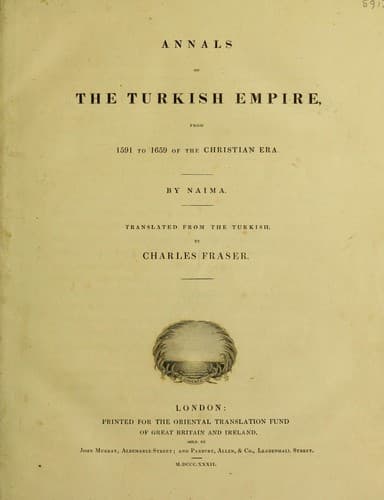
Annals of the Turkish Empire, from 1591 to 1659Naima, Mustafa
History
Annals of the Turkish Empire, from 1591 to 1659
Naima, Mustafa
Turkey -- History -- 1453-1683
Transcriber's note:
Errors and inconsistencies in accented words, mostly
related to Arabic and Turkish names, have been taken care
as much as possible, without attempting however to make a
major revision and overhaul of the original text.
ANNALS
OF
THE TURKISH EMPIRE,
FROM
1591 TO 1659 OF THE CHRISTIAN ERA.
BY NAIMA.
TRANSLATED FROM THE TURKISH,
BY
CHARLES FRASER.
[Illustration]
LONDON:
PRINTED FOR THE ORIENTAL TRANSLATION FUND
OF GREAT BRITAIN AND IRELAND.
SOLD BY
JOHN MURRAY, ALBEMARLE STREET; AND PARBURY, ALLEN, & CO.,
LEADENHALL STREET.
M.DCCC.XXXII.
LONDON:
Printed by J. L. COX and SON, Great Queen Street,
Lincoln’s-Inn Fields.
TRANSLATOR’S PREFACE.
History, it has been well observed, is, of all other branches of
human knowledge, the most attractive, and best rewards the efforts of
research. Even the history of the most ignorant and barbarous nations
that have ever peopled the globe, may furnish something, either in
their modes of government, in their forms of religion, or in their
manners, customs, and laws, which is calculated to amuse or instruct.
The knowledge of the springs and motives of human actions, and of
their consequent effects, whether auspicious or inauspicious, and
which operate more or less powerfully on the destinies of the human
race, is, by this channel, conveyed to our minds with a distinctness,
perspicuity, and force which cannot, by any possibility, be gained in
any other way.
By the investigation of history we become acquainted with points of
character of the utmost importance, and arrive at the conviction that
good and evil are, in some way or other, combined and interwoven in
the affairs of life: and we may often, without difficulty, trace the
happiness or misery of millions of human beings to the act of a single
individual; and perceive that impressions have thereby been made that
stamp, for ages, the moral and intellectual character of mankind.
Without adverting to the rise and downfall of the Roman Empire, out
of the dismemberment of which have arisen the principal States of
Europe, we would merely refer, at present, to the rise, progress, and
establishment of Mohammedanism, the followers of which conquered, sword
in hand, the whole of the rich and fertile provinces possessed by that
empire in the East.
To trace the rise, progress, and final establishment of the Mohammedan
power, from its commencement under Mohammed Mustafa, the prophet of
Islamism, and its successive triumphs under the Khalifs, his immediate
successors, would be to detail a series of revolutions and successions
of dynasties, the most eventful and extensive, the most disastrous and
appalling, that have ever taken place on the theatre of our world.
Public-domain text, read in full here on John Shaqi.
Reviews
Reviews
No reviews yet
Be the first to share your thoughts on this work.
Join the Discussion
Join the discussion
Sign in to leave a comment or review.
Sign InorCreate an account