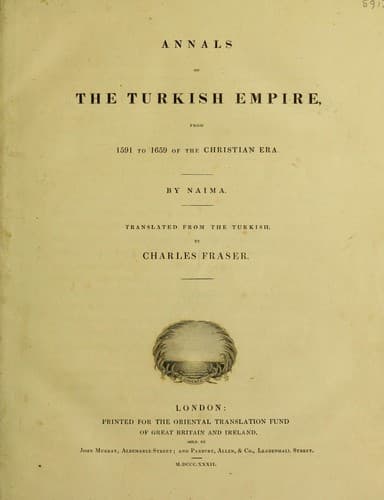
Annals of the Turkish Empire, from 1591 to 1659Naima, Mustafa
History
Annals of the Turkish Empire, from 1591 to 1659
Naima, Mustafa
Turkey -- History -- 1453-1683
Ghází Gheráí having been reinstated in the regal authority, the Mirzás
and Tátárs yielded obedience to his firmáns, and all rancour and
dispute was at an end. Fateh Gheráí, it must be acknowledged, was an
excellent man, a great hero, and well qualified to fill a throne. By
Jeghala’s uncalled-for interference in his favour he eventually lost
his life, and his whole family were rooted out from the face of the
earth.
Ghází Gheráí, now absolute and supreme, commanded a fortress to
be erected in the heart of Circassia, which was afterwards fully
completed. Khundán Aghá returned with great joy to Constantinople, and
related the success of his mission to the Crimea; but the emperor was
so very much displeased with him for the conduct he had pursued, that
his case was deferred for future consideration.
_New appearances of hostilities._
The loss of Yanuk on a former occasion, the conquest of Agria, and
the immense loss sustained in the valley of Mehaj this year, were
disasters, no doubt, which must have sensibly affected the Emperor of
Austria. He soon showed that this was really the case; for the grand
sultán had scarcely returned to his metropolis, when the Austrian
emperor again assembled another vast army, which was ordered to march
on Yanuk. Satúrjí Mohammed Páshá, who was appointed commander-in-chief,
wrote a statement of the ill condition of the troops under his command
to the grand vezír, who again laid it before his majesty. Accordingly,
stores of all kinds and ten thousand ducats from the imperial coffers
were immediately voted for his use. The grand vezír himself made a
present of his own horses and beasts of burden, and the other vezírs
followed his example. Five regiments or legions and ten thousand
Janissaries, under the command of Alí Aghá, the deputy of the ághá of
the Janissaries, were appointed to take the field. Ahmed Effendí, son
of Etmekjí, was appointed military treasurer, and one thousand yúks
of money were put under his charge for the purpose of defraying the
expense of the war. The troops of Romeili, of Anatolia, of Caramania,
of Sivás, of Diárbeker, of Merœsh, and of Ruka, were all ordered on
this expedition. Letters were also issued to the Tátár Khán, ordering
him to be present with his troops.
The serdár or commander-in-chief, after the above arrangements were
fully attended to, commenced his march to Adrianople, reached Sofia on
the 7th of Dhu’l hijja, and the plains of Belgrade on the 29th of the
same, which concluded the year.
EVENTS OF THE YEAR 1006 H.
On the 2nd day of the new year, _i.e._ the 2nd of the month Moharrem,
the commander-in-chief entered Belgrade with his army, and there they
rested for the space of twenty days, during which time provisions and
other necessaries were distributed among the various troops.
Public-domain text, read in full here on John Shaqi.
Reviews
Reviews
No reviews yet
Be the first to share your thoughts on this work.
Elsewhere in the archive
Join the Discussion
Join the discussion
Sign in to leave a comment or review.
Sign InorCreate an account