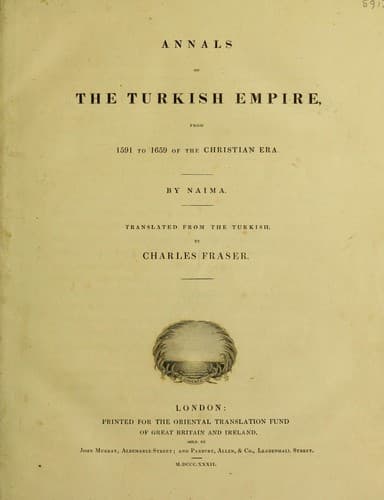
Annals of the Turkish Empire, from 1591 to 1659Naima, Mustafa
History
Annals of the Turkish Empire, from 1591 to 1659
Naima, Mustafa
Turkey -- History -- 1453-1683
Khundán Aghá set out with these two royal letters and landed at Kafa,
in the Crimea, but found on his arrival there that Ghází Gheráí had
already embarked for the imperial dominions, though he had not yet
sailed. The officer, forgetting his instructions, attached himself
exclusively to the interests of the ex-khán, and without further
inquiry delivered the packet addressed to him, and exercised, besides,
other unwarrantable liberties. The ex-khán, on receipt of the above
packet, disembarked and returned to Kafa, took advantage of the frauds
exercised by the officer, showed the documents from Constantinople of
which the officer was the bearer, and, lastly, announced himself as
recalled by these documents to the exercise of the khánship.
When Fateh Gheráí perceived what was going on to his prejudice, as now
mentioned, he bestirred himself in order to thwart the purposes and
endeavours of the ex-khán. He, too, produced a royal mandate, which he
said had been sent to him, and which confirmed him in the khánship.
Hence arose a very serious dispute between these two royal brothers
respecting the khánship: the Tátárs became divided. Abdur-rahmán
Effendí maintained, that as Fateh Gheráí’s document was more recent,
it ought to be regarded as the only one which had any claim, and as
dispossessing Ghází Gheráí for ever of the throne of the Tátárs. The
mufti of Kafa thought otherwise. He said that all the imperial commands
which had been received acknowledged Ghází Gheráí as the legitimate
sovereign of the Crimea; that they confirmed him in the exercise of
regal authority; and that the document which Fateh Gheráí had presented
was altogether doubtful, if not an artifice to impose upon them. One
single paper, letter, or written document, he further maintained, was
not sufficient of itself for them to act upon; and to do so would be
both injudicious and imprudent. There can be no doubt, continued the
mufti, that to disobey or disregard the imperial authority, as vested
in the person of Ghází Gheráí, will be considered as obstinacy and
rebellion. After having delivered this speech he gave forth judgment
in favour of Ghází Gheráí, rejecting Fateh Gheráí’s pretensions
altogether as spurious. The whole of the tribe followed the high
priest, and declared in favour of Ghází Gheráí, leaving Fateh Gheráí
the victim of astonishment and surprise. Some forward persons, more
zealous than prudent, insisted that he, Fateh Gheráí, should do homage
to his elder brother and make an apology to him. The simple-hearted
prince, influenced by the arguments which were employed to incline
him to do so, went to his brother and did as he was required; but it
proved fatal to him. On coming out from his brother’s presence he was
met by a body of mirzás, adherents of the former, who fell upon him and
murdered him, cutting him to pieces. Not satisfied with this, they also
extirpated the whole of his family, leaving neither root nor branch.
Public-domain text, read in full here on John Shaqi.
Reviews
Reviews
No reviews yet
Be the first to share your thoughts on this work.
Elsewhere in the archive
Join the Discussion
Join the discussion
Sign in to leave a comment or review.
Sign InorCreate an account