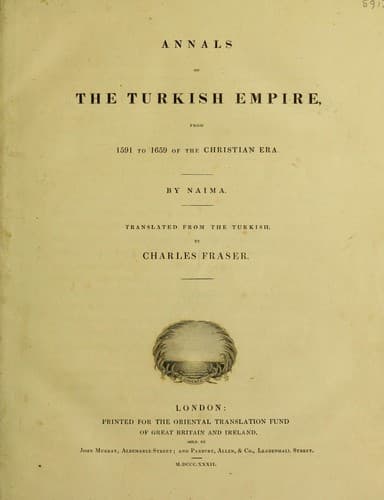
Annals of the Turkish Empire, from 1591 to 1659Naima, Mustafa
History
Annals of the Turkish Empire, from 1591 to 1659
Naima, Mustafa
Turkey -- History -- 1453-1683
Satúrjí Mohammed Páshá, the commander-in-chief in the late campaign,
in order to exonerate himself from any blame which might attach to
him for not having been so successful in the late war as had been
expected, represented his want of success to the failure of the Tátár
khán’s fulfilling his injunctions to come to his assistance, and to
the smallness of the number of troops which acted under him. This
statement made no pleasant impression on the mind of the emperor, who
was by this time but too much displeased with the grand vezír for the
part he had acted towards this khán on a former occasion, as we have
already related in a preceding chapter. On this account, therefore,
as well as for some offence which the grand vezír had given to the
queen-mother; and also on account of some handsome presents which
Khádum Hasan Páshá had made: and moreover, because Ibrahím’s capacity
for governing had become more and more disputed, the emperor, for
these reasons, one day called the mufti into his royal presence and
began his conversation thus: “I purpose,” said the monarch, “to make a
change in the premiership: whom do you think worthy of being elevated
to that station?” The reverend mufti replied, that if he meant to
dismiss his servant Ibrahím, it must, of course, be for some crime.
What is that crime? The emperor, having thought a little, said “that
there was no end to his crimes,” and adverted to the part he had acted
with regard to the two Tátár princes. “Was it, think you,” said the
sublime monarch, “a crime of small magnitude that he should have been
the means of the death of Fateh Gheráí, and all its consequent evils?”
The reverend mufti, after hearkening to this apostrophe, proposed Jeráh
Páshá, the senior vezír. The emperor demurred, and said Jeráh had no
capacity for managing affairs; and that therefore he preferred giving
the office to Khádum Hasan Páshá, whose superior wisdom and prudence
was spoken of through the whole city of Constantinople. The reverend
mufti bowed, joined in his praises, and exaggerated his endowments.
On the 23d of Rabia II., after the sitting of the diván, the ketkhodá
of the household troops, Abdullah Aghá, was deputed by his majesty to
wait on Ibrahím and receive back the seals from him, and to present
them to Khádum Hasan Páshá. Ibrahím Páshá went to live in his own
garden, near the new emporium at Uskudár.
Public-domain text, read in full here on John Shaqi.
Reviews
Reviews
No reviews yet
Be the first to share your thoughts on this work.
Elsewhere in the archive
Join the Discussion
Join the discussion
Sign in to leave a comment or review.
Sign InorCreate an account