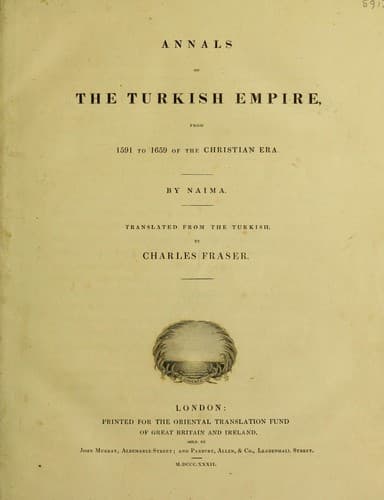
Annals of the Turkish Empire, from 1591 to 1659Naima, Mustafa
History
Annals of the Turkish Empire, from 1591 to 1659
Naima, Mustafa
Turkey -- History -- 1453-1683
Khádum Hasan Páshá, in consequence of his splendid gifts and presents
to the queen-mother, and of his many promises of rendering service
to the state, was raised, in the course of that passing week, to
the dignity of grand vezír. This man, as might easily have been
anticipated, was attentive to nothing but his own aggrandizement, and
how to increase his own wealth. During the whole time he continued
in office, he sold places, received immense bribes, and amassed vast
riches. When any one asked him for a situation he used to say: “Do you
know to whom I shall give the presents you have sent me?” and other
similar impertinent questions. This exalted personage, however, soon
fell under the execrations of the people, and became every day more and
more hated and despised, but yet no one was able to oppose him.
One day, when his majesty went to St. Sophia, to offer up his devotions
in that temple, some desperate fellows approached him and requested
permission to slay his minister. His majesty, thinking it was out of
mere ill will they had so petitioned him, did not give his consent, and
they immediately desisted from their purpose. The emperor, however,
mentioned the circumstance to his mother, who let Ghaznafer Aghá into
the secret, and with him she concerted the overthrow of the prime
minister. He maintained that Hasan Páshá not only openly received
bribes, but that he had also cut off the supplies of the queen-mother;
that he had published complaints against her among all ranks of the
community, and thus made her the subject of conversation; that by
these and similar means he sought to rouse her servants to rebellion,
and herself to be removed to a distance from the court, in order that
he might obtain absolute power. All this representation, or rather
accusation, was confirmed by the ághá of the Janissaries, Ternakjí
Hasan. The emperor issued orders to investigate into the fact. But
those who were appointed to do this returned a verdict similar to the
above statement of accusation, or at least confirmatory of it.
In the meantime the reverend mufti, Bostání Zádeh, died, when Hasan
Páshá conferred the duty of expounding the law on the poet Bákí
Effendí, in conjunction with Karah Chelebí Zádeh. But the emperor not
approving of his choice, appointed Khoja Sa’d-ud-dín Effendí, with a
part of whose history we are already acquainted, and whom we saw lately
condemned to live the life of a hermit, to be mufti in room of Bostání
Zádeh. Notwithstanding this, however, Hasan Páshá wrote three times
officially on this subject to Bákí Effendí, and tried what he could to
prevent Sa’d-ud-dín succeeding to the muftiship; a circumstance which
awakened old but buried animosity and unpleasant correspondence between
the old prelate and the grand vezír. The conduct of the latter roused
the emperor’s anger, and without further delay he installed the old
reverend prelate into the office of mufti.
Public-domain text, read in full here on John Shaqi.
Reviews
Reviews
No reviews yet
Be the first to share your thoughts on this work.
Elsewhere in the archive
Join the Discussion
Join the discussion
Sign in to leave a comment or review.
Sign InorCreate an account