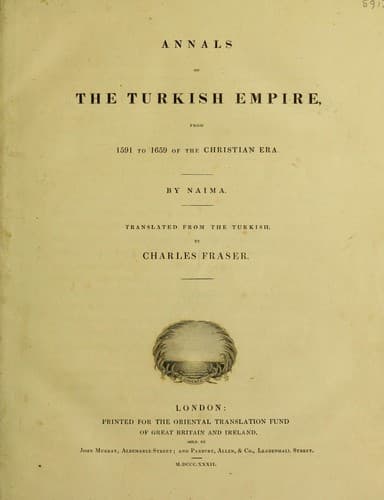
Annals of the Turkish Empire, from 1591 to 1659Naima, Mustafa
History
Annals of the Turkish Empire, from 1591 to 1659
Naima, Mustafa
Turkey -- History -- 1453-1683
Whilst the council was employed in consulting about these matters,
official documents were received from the commander-in-chief, which
confirmed the statements before made. It was the opinion of the grand
vezír, Jeráh Mohammed Páshá, that as the enemy was in possession
of the districts about Yanuk and Osterghún, the commander-in-chief
should direct his movements against the Transylvanians, who had, as
before observed, invaded the jurisdiction of Temiswar. As the frontier
fortresses in that quarter were all well furnished with men and
provisions, he observed, it seemed most prudent on this account to make
Transylvania the scene of the war. They all agreed that unless the
Transylvanians were thoroughly chastised, it would be impossible to
keep Valachia and Moldavia in a state of subjection. The royal mandate
for commencing this war was issued and sent to the commander-in-chief,
accompanied by a robe of honour. At the same time letters, and also
money, according to ancient custom, were sent to the khán of the
Tátárs, desiring him to assist the serdár with a Tátár army. The feudal
tenantry in Turkey who held superiorities sold them, received double
wages, and took their dependants. Five hundred yúks of money from the
imperial coffers were sent along with the camp, and the above tenantry
for the serdár. They departed from Constantinople for Belgrade in the
beginning of Shabán, which happened to be his majesty’s birth-day. The
camp of the serdár was erected on a hill called Khúnkár, in the plains
of the last-mentioned city, on the 12th of Ramazán. On the 23rd of
Shevál Válí Páshá, the beglerbeg of Romeili, who had wintered at Uskúb,
joined the commander-in-chief’s camp at the above place. On the 14th of
Dhu’l kada the serdár himself joined his army; and, after having had
information as to the certainty of the Tátár khán’s approach, sent off
couriers to the different cazís along the Danube, ordering them to have
provisions in readiness.
After it had been fully resolved on to carry the war into Transylvania,
a bridge was commenced on the 9th of Dhu’l hijja at a place or
promontory on the Danube called _Táshluk Búrún_, somewhere below
Belgrade, and which was completed in eighteen days, though it extended
1,850 cubits in length.
On the day the army began to cross over into the country of
Transylvania the serdár received certain information that the Tátár
khán with his army had reached Rusjuk. The provincial troops of
Caramania and Merœsh, with their respective chiefs, who had been
sent to garrison Buda, passed through the plains of Belgrade and
followed the grand army into Transylvania. Towards the end of Dhu’l
hijja the Moslem serdár or commander-in-chief joined his army, which
halted in the plains of Petcheva; but we must defer relating the
history of this war till we review the events of the following year.
_State of affairs in Bassra._
Public-domain text, read in full here on John Shaqi.
Reviews
Reviews
No reviews yet
Be the first to share your thoughts on this work.
Elsewhere in the archive
Join the Discussion
Join the discussion
Sign in to leave a comment or review.
Sign InorCreate an account