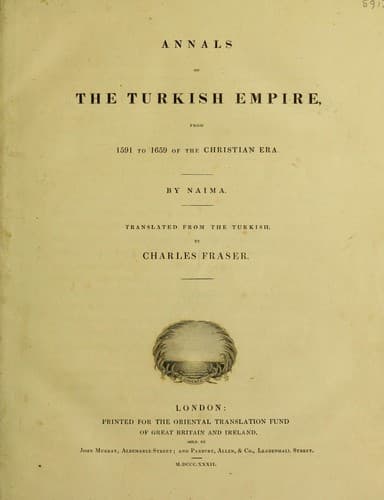
Annals of the Turkish Empire, from 1591 to 1659Naima, Mustafa
History
Annals of the Turkish Empire, from 1591 to 1659
Naima, Mustafa
Turkey -- History -- 1453-1683
It has been said that the commander of the Janissaries of Yanuk
was brought alive, but in a state of drunkenness, before the
above-mentioned impious Palghi, kapúdán of Komran, and that ten or
fifteen thousand pieces of gold were found in his possession. After
interrogating him, the story goes on to say, as to what he meant to do
with such a quantity of money, and asking him why he had not laid it
out on the garrison, or if he thought that his money would watch the
fortress, the commander caused his head to be cut off and fixed upon a
pole. The same account also states that, notwithstanding the general
carnage, five or six Muselmans made their escape to Buda; the rest
were totally annihilated. The beglerbeg of Buda sent a report of this
disastrous affair to the commander-in-chief, which reached him on the
29th of Shabán.
The wooden mortars or guns above alluded to were something in the form
of a cannon—large mortars made of bronze, and surrounded by five or six
iron rings on the outside. Each mortar had two ears of the same metal
with itself, and the whole piece or apparatus was placed in a wooden
frame or case about as large as a small mat or carpet (about the size
of a hearthrug) and four or five fingers thick, and in which these ears
were fixed. The point of the mortar was seen outside of the frame, and
when it was charged with powder a circular plate was firmly fixed to
its mouth by ropes or straps. These mortars were placed on two-wheeled
carriages, which were provided with a long rod or pole behind them to
prevent the wheels or carriage, when the mortars were discharged, from
diverging from the proper line. Such were the instruments employed on
the above occasion.
_The Moslems determine on attacking Warad._
When the winter season was nearly over, and the approach of spring at
hand, Satúrjí Mohammed Páshá, who had taken up his winter quarters
in Belgrade, and still retained the office of commander-in-chief,
though in the last campaign he had accomplished nothing of importance,
but permitted Yanuk to fall, and who seemed pleased with the apology
which the Tátár khán thought proper to offer for his negligence,
determined on renewing hostilities as soon as the season should permit.
Accordingly every preparation necessary for the undertaking was seen
to, and his camp was soon pitched in the plains of Belgrade. A great
quantity of money and of troops were on this occasion ordered to be
sent to him.
In a council held at Constantinople it was declared, by persons well
acquainted with the state and condition of the frontiers, that the
fortresses of Lipa, Yanwa, Warad, and Jena, in the jurisdiction of
Temiswar, had been seized on by the enemy, and that if active measures
were not timely adopted, Temiswar would most assuredly be wrested also
from the Moslem grasp.
Public-domain text, read in full here on John Shaqi.
Reviews
Reviews
No reviews yet
Be the first to share your thoughts on this work.
Elsewhere in the archive
Join the Discussion
Join the discussion
Sign in to leave a comment or review.
Sign InorCreate an account