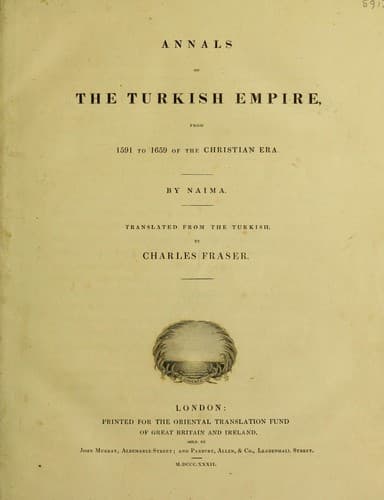
Annals of the Turkish Empire, from 1591 to 1659Naima, Mustafa
History
Annals of the Turkish Empire, from 1591 to 1659
Naima, Mustafa
Turkey -- History -- 1453-1683
_Account of the late expedition continued from last year._
We have already, in a former section, noticed the purport of this
expedition, and left the grand army encamped in the plains of Petcheva.
On the 25th of Dhu’l hijja of that year they reached Betchgarak, where
they halted for some time.
About the middle of the thousand and seventh Moharrem (_i.e._ about
the middle of the month Moharrem, 1007 of the Hijrah), Válí Páshá,
beglerbeg of Romeili, died; and Mohammed Páshá, beglerbeg of Anatolia,
who had been stationed at Usk, was appointed to succeed him, and
immediately joined the grand army. Mohammed Páshá was succeeded at Usk
by Súfí Sinán Páshá, beglerbeg of Agria; and he again was succeeded by
Bektásh Páshá, governor of Solnuk.
At Betchgarak, a place rendered sacred by the death of the late
beglerbeg of Romeili, the army remained full fifty-five days waiting
for the arrival of the Tátár khán and his subsidiary troops.
During the stay of the grand army at this place, it happened that
messengers arrived from Buda who informed the commander-in-chief that
the fortress of Tata had been taken by the enemy, and immediately after
this other messengers brought him intelligence from Alba Julia that
Pulata was besieged. Without loss of time, therefore, and in the utmost
haste, he issued orders to the troops of Semendria to march to Buda and
strengthen that garrison.
In the meantime, information reached the Moslem camp that Ghází Gheráí
Khán, with his Tátár troops had arrived in the neighbourhood; and on
the 26th of Moharrem the khán joined the royal army with forty-five
thousand men. The Moslem serdár, on his approach, went out with great
pomp and shew, to meet his royal highness, and to perform the honours
due to him, and which were usual on such occasions; he also prepared a
splendid entertainment for him and his suite. The royal khán, in his
turn, made a suitable acknowledgment to the serdár and to the other
magnates of the Moslem camp. After the entertainment was over, the
serdár conducted his royal highness to his pavilion, and returned to
his own. He caused, however, another tent to be erected for the khán
near his own, and one for his females; and provided them with every
thing necessary for their accommodation and comfort. To each of one
hundred of the khán’s mirzás a robe of honour was given: but to the
royal auxiliary himself a splendid robe, an embroidered coat, two
Agria horses, and a saddle and bridle richly ornamented with gold and
precious gems were presented.
Public-domain text, read in full here on John Shaqi.
Reviews
Reviews
No reviews yet
Be the first to share your thoughts on this work.
Elsewhere in the archive
Join the Discussion
Join the discussion
Sign in to leave a comment or review.
Sign InorCreate an account