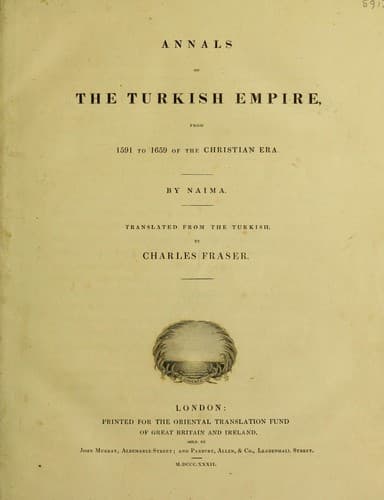
Annals of the Turkish Empire, from 1591 to 1659Naima, Mustafa
History
Annals of the Turkish Empire, from 1591 to 1659
Naima, Mustafa
Turkey -- History -- 1453-1683
On the 27th, the commander-in-chief or serdár, the princes and
commanders of regiments went to pay their respects to his royal
highness, when a royal mandate which had been received from
Constantinople was read in the presence of these august personages.
After the mandate was read, the khán, the serdár, and the other
dignitaries present, stood up, offered up a prayer, and then
immediately entered into consultation as to the best means for
accomplishing the object of the expedition. The question as to the
route they should take formed one of the topics which occupied their
minds on this important occasion. After a good deal of conversation on
this subject, the chiefs of the borders observed, that there were three
roads which penetrated Transylvania. The first led to the fortress of
Lipovah; the second, to Sibish and Loghúsh; and the third, to Warad.
His royal highness Ghází Gheráí observed, it would be most proper to
go by the one which could be shown to be the most eligible for the
transporting of cannon and heavy baggage, and on which they could most
easily defend themselves in the event of being attacked. One of the
most distinguished of the border leaders replied by saying: “Sire, the
roads of Sibish and Loghúsh, and of Lipovah, are both difficult and
dangerous, and afford no means of defence against the enemy should
they be disposed to attack us. The road leading to Warad, on the
contrary, is broad and open, and on this account, as well as others, it
is the most preferable one: besides, it is the only one of the three
in which we can most efficiently as well as conveniently, accomplish
our object—the chastising of the Transylvanians.” “But,” said the khán,
“will the infidels of Warad not endeavour to intercept or ensnare us?
In the event of their attempting any of these expedients, is there no
danger, and shall we not be obliged to relinquish our object? In the
event of our succeeding in reducing it, can we keep possession of it
after we have taken it?” He asked further, whether the reduction of
the place would likely occupy much time. With the view of doing honour
to the prowess of the serdár, it was replied, though falsely, that two
or three pieces of ordnance were quite sufficient for the purpose of
accomplishing the reduction of Warad; and that, afterwards, they could
advance against Zighmund (probably the prince of Transylvania). This
representation weighed with the council. Etmekjí Zádeh, the defterdár
of the expedition, attended to every thing necessary for the attempt,
and provided the army with apparatus for occupying the fortress.
Public-domain text, read in full here on John Shaqi.
Reviews
Reviews
No reviews yet
Be the first to share your thoughts on this work.
Elsewhere in the archive
Join the Discussion
Join the discussion
Sign in to leave a comment or review.
Sign InorCreate an account