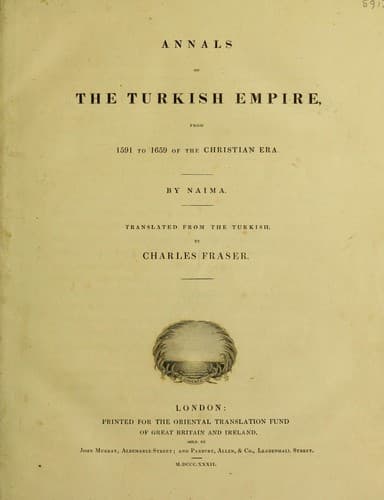
Annals of the Turkish Empire, from 1591 to 1659Naima, Mustafa
History
Annals of the Turkish Empire, from 1591 to 1659
Naima, Mustafa
Turkey -- History -- 1453-1683
The fortress of Warad, before which the Moslem army took up its
position on the 29th, was situate on the boundaries which separate
Germany and Transylvania, was very strong, and surrounded by suburbs
and villages. So very large and extensive a place was Warad that it
could easily contain twenty thousand troops. Its gardens reached from
the suburbs to Pest, and its country houses and other dwellings were no
less extensive in number, it is conjectured, than the number which at
that time were between Constantinople and the gardens of Dávud Páshá.
It is impossible to describe accurately the whole of the gardens and
orchards, and the multitude of the inhabitants of Warad. Some one or
two years before the period we are now speaking of, a German army of
several thousands took possession of it, and had it in subjection when
the orthodox army, under the grand vezír and commander-in-chief Jeráh
Mohammed Páshá, appeared before it. The suburbs and villages were
inhabited by Hungarians.
_Warad besieged._
When the Tátár troops advanced to attack the suburbs of Warad, the
inhabitants came boldly forth, and for a whole day and night fought
with courage. But the Tátárs no sooner succeeded in setting fire to
their dwellings than they retired, put their families into waggons, and
tried to escape through their postern gates. The Tátárs pursued them
with vigour, slew the grown-up, made the young prisoners, and returned
with immense booty.
Immediately after these things, the khán of the Tátárs, and the serdár
of the Moslems, and other great men in the army formed themselves into
a council of war, and took into consideration whether they should
proceed onwards and desolate the country, or stop where they then were
and endeavor to vanquish the fortress of Warad. The whole council were
unanimous in thinking the latter plan the most advisable. So important
and so strong a place, and so very near the frontiers of the Ottoman
dominions, and which at once formed a key to Germany and Transylvania,
they unanimously considered ought not to be allowed to remain in the
hands of the enemy, and they therefore determined at once on reducing
it.
Public-domain text, read in full here on John Shaqi.
Reviews
Reviews
No reviews yet
Be the first to share your thoughts on this work.
Elsewhere in the archive
Join the Discussion
Join the discussion
Sign in to leave a comment or review.
Sign InorCreate an account