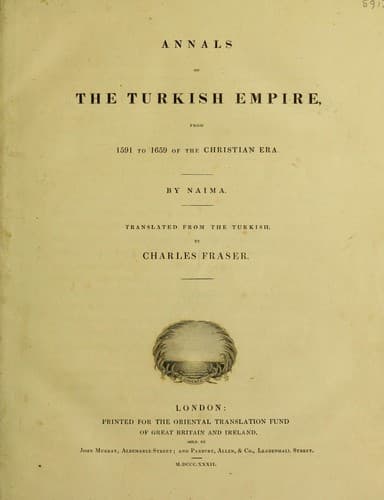
Annals of the Turkish Empire, from 1591 to 1659Naima, Mustafa
History
Annals of the Turkish Empire, from 1591 to 1659
Naima, Mustafa
Turkey -- History -- 1453-1683
In consequence, however, of the great length of time which had elapsed,
since leaving Belgrade, including the fifty-five days they had to wait
for the khán, the half of the season for carrying on hostilities was
past, but still they were determined to do what they could. About the
middle of the month Sefer, one Yúghen, an ághá of Temiswar, and one
who was well acquainted with the roads, was appointed to conduct the
Moslem army to Warad. They reached a fortress on the river Murish,
called Jenad, before which they sat down and prepared for laying siege
to it. After the firing of a few guns, however, its inhabitants and
garrison became dismayed, abandoned it, and fled to the mountains and
thickets adjacent. This fortress, of course, was immediately taken
possession of, whilst the Tátár troops pursued the fugitives; killed
some, and took most of the rest prisoners. One hundred and fifty of
these vile wretches were brought to the door of the serdár’s tent, and
there beheaded. Jenad was put under the jurisdiction of prince Ibrahím
Shikshái, inspector of Belgrade.
From Jenad the army marched to a palanka called Dilagúsh, and thence
proceeded to Arad, of which, finding it deserted by its inhabitants,
they took possession.
Shortly after this, messengers arrived from the prince of Transylvania
with letters to his highness, the khán of the Tátárs, requesting
conditions of peace, or rather requesting the khán to intercede with
the Ottoman emperor and endeavour to bring about a peace. About the
same time also a great quantity of rain fell, which exceedingly annoyed
the Moslem troops.
On the 9th of Sefer Mustafa Páshá, the beglerbeg of Erzerúm, joined the
grand army with his provincials. On the 11th, the whole army crossed
the Murish, but experienced the greatest difficulty in doing so. They
marched along its banks for several stages, and stopped at a bridge
near a deserted palanka, called Ordúbek. At length, after experiencing
a thousand hardships in crossing rivers and passing through extensive
marshes, they arrived in the plains of Warad on the 24th of the month,
where they were joined by the beglerbeg of Wán, Yúsuf Páshá having
previously been joined, whilst at Ordúbek, by the army of Gula. Two
badlooshkas also, the one from Gula and the other from Temiswar, were
sent to them. The Tátár khán, on the army’s leaving Jenad, took a
different route with the intention of distressing and annoying the
peasantry throughout the country, and joined the grand army again at
Warad.
Public-domain text, read in full here on John Shaqi.
Reviews
Reviews
No reviews yet
Be the first to share your thoughts on this work.
Elsewhere in the archive
Join the Discussion
Join the discussion
Sign in to leave a comment or review.
Sign InorCreate an account