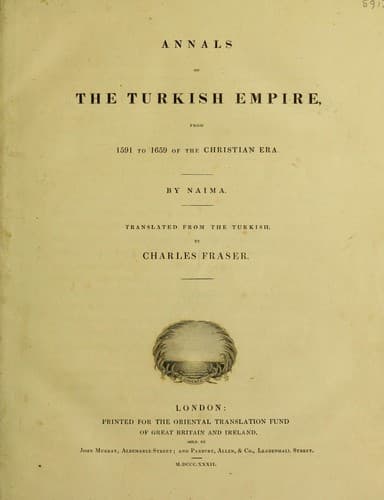
Annals of the Turkish Empire, from 1591 to 1659Naima, Mustafa
History
Annals of the Turkish Empire, from 1591 to 1659
Naima, Mustafa
Turkey -- History -- 1453-1683
The Tátárs, at this time, requested permission to range the country,
and commit what devastation they could, but the serdár refused to
give his consent; saying, he hoped to God they would yet take Warad,
and they would afterwards proceed together. It happened also, in the
mysterious providence of God, that for the space of forty days it
rained successively, and the rain which thus fell ran in torrents
through the plains and valleys. The ground everywhere round Warad
became soft, and in several places marshes were formed. The ditches
which the Janissaries had prepared were all filled with water and clay,
and the Janissaries themselves were forced to retire to their tents.
The whole of the army in these adverse circumstances became completely
discouraged, particularly the officers. The stream which issued from
the city swelled to such a degree as to become unpassable. In fact, it
was at last impracticable to go from one tent to another. The winds
also rose so awfully high as to tear away the very poles of the tents
out of the ground, and the cattle sunk to their bellies in the mud.
The troops also were for several days without meat, but this want was
supplied by a great number of sheep which had been driven to the plains
of Warad. The most of these sheep were sent thither by the peasants
of Solnuk, and nearly filled the whole country round Warad. The cursed
prince of Transylvania, they were also informed, had secured himself in
inaccessible mountains.
The Moslem army were thus exposed to all the inclemency of the weather,
and to every possible hardship, and distressed and annoyed by the
water which ran in torrents through their camp. In short, all this
accumulation of adverse circumstances completely overcame the spirit of
the Moslem troops: they became totally heartless, and could do nothing.
In the midst of all these indescribable distresses they were informed
by messengers from Buda that no fewer than 80,000 of the enemy had
attacked and destroyed Old Buda, and that at that very moment their
large cannon were employed in battering Buda itself. They added, that
if immediate aid were not afforded, Buda could not fail to fall into
the enemy’s hands. They had heard at an earlier period of the same day
on which this news was brought them, that a heavy body of the enemy had
passed through Yanuk and Wáj, and had gone to Old Buda. The persons who
brought the above intelligence maintained it was of no use to send one
or two thousand men; it was absolutely necessary, they said, that the
serdár should go in person with his whole army.
Public-domain text, read in full here on John Shaqi.
Reviews
Reviews
No reviews yet
Be the first to share your thoughts on this work.
Elsewhere in the archive