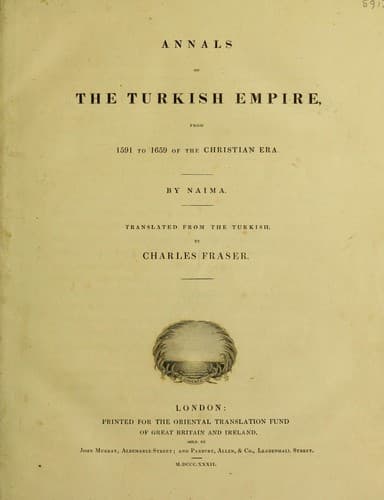
Annals of the Turkish Empire, from 1591 to 1659Naima, Mustafa
History
Annals of the Turkish Empire, from 1591 to 1659
Naima, Mustafa
Turkey -- History -- 1453-1683
These sad and unwelcome messengers astonished and confounded the
afflicted serdár and his suffering army by the intelligence they
brought him. But his misfortunes were only increasing. The very
adverse circumstances in which the Moslem army were placed, and the
advance of the enemy against Buda, afforded a favourable opportunity
to the treacherous Michael, of cursed memory, to cross the Danube,
to attack the vezír Háfiz in Nicopolis, causing him to seek his
safety in flight; and to commit the most dreadful depredations. This
information became no sooner public, and its truth confirmed, than it
increased, of course, the embarrassments of Satúrjí Mohammed Páshá, the
commander-in-chief. But they had still to increase: Tata, Besperim,
and Papa also fell into the hands of the hateful infidel enemy. These
things were more than sufficient to confound all judgment. They were
awful, terrible, and afflictive beyond expression: nevertheless, the
serdár still bore up under all the misfortunes of the campaign. He
determined, notwithstanding his perilous condition, to afford what aid
he could to the quarter above mentioned. Yet in a council afterwards
held, and in which the khán and the other magnates of the army were
consulted, the difficulty of sending foot soldiers became quite
apparent. Not only the distance but the difficulty which such troops
would have to encounter in crossing rivers like seas, the Danube, and
the Tise (Tibiscus), was clearly discerned to be beyond the power of
any but horsemen to accomplish. It was therefore agreed that a party of
some thousands of the Tátár rangers should be despatched without any
further delay as far as Pest, where they were to spread a report that
the khán and the serdár would soon appear with their respective troops,
and afford them effectual aid. This measure, it was conjectured, would
have the effect of strengthening such as had not fallen into the hands
of their enemy, and of discouraging, if possible, the latter. The Tátár
detachment proceeded.
In the meantime, the commander-in-chief was still looking in vain for
the arrival of the cannon from Agria. But, alas! he was disappointed.
Súfí Sinán Páshá arrived in the camp empty-handed. On being
interrogated why he did not send the ten pieces of cannon as commanded,
he returned for answer the senseless excuse, that no buffaloes could be
had to transport them. It can easily be imagined what was the grief and
affliction of the Moslem army, but it cannot be described. The whole
of the provisions which they had been able to find in the vicinity of
Warad was consumed, and the Tátárs were obliged to bring from a great
distance to the camp what flour or grain they were able to find. A keil
(measure) of barley was sold from three to five pieces of gold.
Public-domain text, read in full here on John Shaqi.
Reviews
Reviews
No reviews yet
Be the first to share your thoughts on this work.
Elsewhere in the archive
Join the Discussion
Join the discussion
Sign in to leave a comment or review.
Sign InorCreate an account