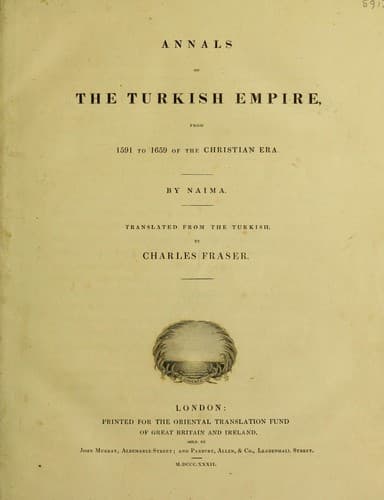
Annals of the Turkish Empire, from 1591 to 1659Naima, Mustafa
History
Annals of the Turkish Empire, from 1591 to 1659
Naima, Mustafa
Turkey -- History -- 1453-1683
The serdár, it must be acknowledged, was the cause of the long delay of
the Moslem army before Warad, and of course, at least in some degree,
of the evils to which they had been subjected. We have already observed
how he refused to allow the Tátárs to go on a predatory excursion
through the country, saying he hoped God would give him the victory in
a day or two. He was miserably mistaken in his hopes, and accomplished
nothing; at least nothing good, as we have seen. The weather now became
so very cold that the men could keep neither hands nor feet warm.
Perceiving, therefore, that Warad was not to be subdued by the means
which he possessed, and as he had caused it to be reported about Pest
that he had raised the siege and had gone to Solnuk with the view of
succouring Buda, the serdár began to retreat. In consequence, however,
of the rivulets every where having swollen into rivers from the late
rains, the páshá of Temiswar, Ismael Páshá, was instructed to advance
and erect bridges for the army; but he did not erect even one; the
army had therefore, in consequence of this neglect, to do the best
they could. They crossed no fewer than twelve rivers, three of which,
however, had bridges over them, of the above description, by means of
rafts, and underwent immense difficulty and danger at every one which
they crossed. Numberless poor animals perished in these waters, and
the troops suffered most severely from the cold. The flour which they
carried along with them was spoiled and caused disease among the men,
and they were therefore obliged to throw it away. Their three pieces
of ordnance they succeeded in getting across these rivers by means of
strong ropes, and Khoja Murád Páshá, who was beglerbeg of Diárbeker,
Mohammed Páshá, beglerbeg of Haleb, and Súfí Sinán Páshá, in order
to encourage the troops, put their own necks into yokes, and helped
to drag them onwards. The distance between Warad and Gula was about
three days’ journey, but required twelve days on this occasion to
accomplish it, during the whole of which time they suffered a thousand
difficulties. Hundreds of men were left on the road by reason of the
cold or hunger, or sunk into the mud.
The army was met by Iskander Beg, who was afterwards created páshá,
and the ketkhodá of Teryákí, Hasan Páshá, in the plains of Gula, who
confirmed the intelligence they formerly had received that Besperim,
Polata, and Tata had fallen into the hands of the enemy, and earnestly
requested the serdár to send off, as soon as possible, what succours
he was able to the aid of those places which had been enabled still
to hold out. The serdár gave him fine promises and sent him away next
morning.
Public-domain text, read in full here on John Shaqi.
Reviews
Reviews
No reviews yet
Be the first to share your thoughts on this work.
Elsewhere in the archive
Join the Discussion
Join the discussion
Sign in to leave a comment or review.
Sign InorCreate an account