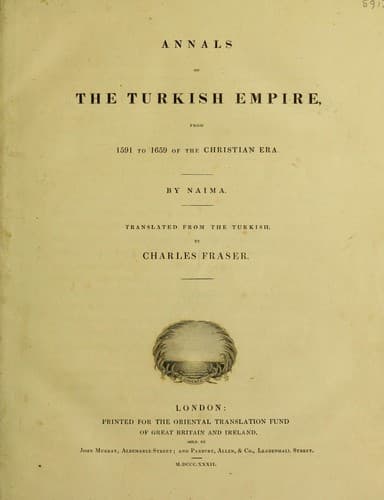
Annals of the Turkish Empire, from 1591 to 1659Naima, Mustafa
History
Annals of the Turkish Empire, from 1591 to 1659
Naima, Mustafa
Turkey -- History -- 1453-1683
On the same day also, Jánbúlád Zádeh Hasan Páshá
joined the royal camp with the troops under his command. On the 10th of
the month, the grand army reached Amrúdlí. But the infidels of Wáj set
fire to this place during the night, and fled. On the 21st, whilst the
grand army remained encamped in the vicinity of Wáj, messengers arrived
from the enemy’s camp, proposing that the Moslem grand army should
postpone any further movement for the space of three days, in order to
bring about, if possible, a pacification. When the third day arrived,
the messenger waited first on the khán, and afterwards on the serdár,
when Murád Páshá, Ahmed Aghá, belonging to his royal highness the
khán, and Mohammed Ketkhodá were appointed commissioners, and ordered
to proceed to the enemy’s camp or tábúr, and negociate a peace. They
returned, however, in two days afterwards without having accomplished
any thing; and the Moslem army, without any further delay, put
themselves again in motion, passed under Novograde, situate on a hill,
without having sustained the least injury from the cannon of that
fortress; and arriving at a new palanka near Waragil, on the banks of
the Danube, opposite Vishégrade, they found it deserted by the enemy’s
troops who had held it in possession. The inhabitants endeavoured to
escape, but were all either killed or made prisoners. This palanka
was surrounded on three sides with a morass: the whole of its cannon
and powder fell into the hands of the Moslems, who set fire to the
place and burned it to the ground. Waragil, on the following day, was
evacuated, in like manner, and burned: nothing but the badness of the
roads saved the infidels of Waragil from experiencing the fate of those
of the palanka.
By this time, the infidel army discovered, as they thought, that the
Moslems meditated an attack on them about the 20th, and conjecturing
they would endeavour to cross by the two bridges which they had erected
below Osterghún, they stationed some of their bravest men in that
quarter, in order to resist them. The serdár, however, pursued the
plan he had first formed, and without a moment of unnecessary delay,
made towards Jegirdilin, where a considerable number of the enemy was
concentrated. Mohammed Khetkhodá thought it would be more advisable
to postpone any attack on the enemy for a day or so, and the khán
was of a similar opinion. The serdár, therefore, delayed; but on the
22nd he entered with his grand army the plains of Jegirdilin, which
so terrified the infidels that they quickly crossed the river and
concentrated themselves somewhere below Jegirdilin, but found that the
two bridges which had been erected there had been cut down. A number of
sick men whom they had left behind were all put to the sword: the grand
army advanced upon Osterghún.
Public-domain text, read in full here on John Shaqi.
Reviews
Reviews
No reviews yet
Be the first to share your thoughts on this work.
Elsewhere in the archive
Join the Discussion
Join the discussion
Sign in to leave a comment or review.
Sign InorCreate an account