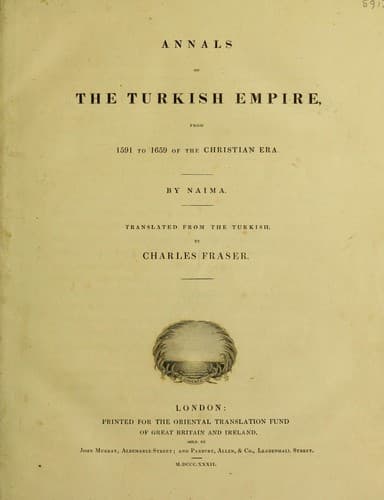
Annals of the Turkish Empire, from 1591 to 1659Naima, Mustafa
History
Annals of the Turkish Empire, from 1591 to 1659
Naima, Mustafa
Turkey -- History -- 1453-1683
In order to deceive the Moslems, and to retard their progress, the
project of negociating a peace was again had recourse to. The serdár
having received letters to this effect, he appointed Murád Páshá,
Mohammed Khetkhodá, and Ahmed Aghá to proceed to the head-quarters of
the enemy and negociate with the Archduke Matthias, the Palfi, and
the Groof. The Moslem commissioners laboured to get Agria exchanged
for Osterghún, but their proposals were received with coldness, and
insurmountable objections started, so that the Moslem commissioners
had to return without accomplishing any thing. Both parties, indeed,
withdrew from the conference, and the enemy retired to Komran.
The commander-in-chief, in a council of the khán’s omerá, determined,
in consequence of the royal firmán for carrying on the war this year
having restricted him to a depredatory mode of warfare, on putting this
method into execution. Accordingly, he sent off a number of warlike
troops along with a Tátár army into the enemy’s territories, to destroy
and seize what they could.
On the 2nd of Rabia II. the army crossed the rivers Abyúl and Warad,
and on the 5th reached the lake of Segmehal, near Uiwar. The predatory
army before-mentioned succeeded in making a number of captives, and
seizing some cattle, but by no means to the extent so powerful an army
was expected to have done. Whilst the serdár remained at Segmehal, the
beglerbegs went to Uiwar, and there learned for certain that the enemy
had retired to Komran.
As the winter was setting in, the ághás of the regiments were put
in mind of this, and instructed to return home. In the Nokhbeh
Tarikh it is said, the grand army returned on the 28th of Rabia II.
to Jegirdilin, passed by Filk and Khutván, and arrived at Pest on
the 6th of Rabia II., when each hired soldier received, in lieu of
provisions, two pieces of gold. On the 14th they reached Buda, when
his royal highness, Ghází Gheráí, khán of the Tátárs of the Crimea,
took his leave, and set out for his own dominions. The exalted
commander-in-chief did all he could to dissuade him, but in vain. His
royal highness was certainly not well pleased, and when he was urged
to remain he replied, that the time for the Tátár army to retire had
arrived; and accordingly he set off. It does not appear that there was
any particular intimacy between the khán and the serdár, though the
latter was not wanting either in politeness or attention. The fact
is (for what reason does not appear), that the khán was never once
pleasant, nor even showed an agreeable countenance. He never once
entered the serdár’s tent, and their intercourse, for the most part,
was on horseback.
Public-domain text, read in full here on John Shaqi.
Reviews
Reviews
No reviews yet
Be the first to share your thoughts on this work.
Elsewhere in the archive
Join the Discussion
Join the discussion
Sign in to leave a comment or review.
Sign InorCreate an account