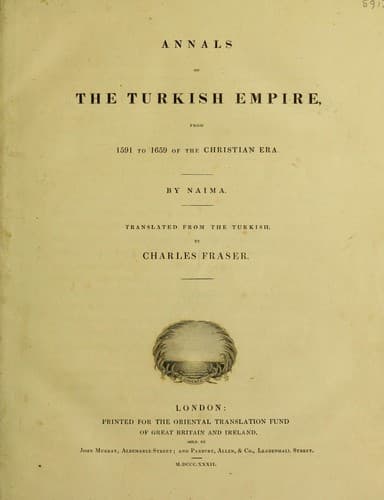
Annals of the Turkish Empire, from 1591 to 1659Naima, Mustafa
History
Annals of the Turkish Empire, from 1591 to 1659
Naima, Mustafa
Turkey -- History -- 1453-1683
Sultán Osmán Khán in his wars, and were most serviceable to him whilst
engaged against the northern nations. These French or Franks did not
kill in the ordinary way. Such of the Russians and Cossacks as fell
into the hands of the Moslems were delivered over to these Franks, who
first fixed them alive on spits, and then roasted them before a fire,
turning them round and round till they perished by the process.
_Laudable qualities of Ibrahím Páshá._
Petchoghli says that Ibrahím Páshá, the commander-in-chief, was a man
of exemplary humility, possessing great benignity of nature and extreme
meekness. So great was his compassion and commiseration when any one
was brought before him for any crime, that he not unfrequently betrayed
weakness. On a certain occasion, when some peasants were brought into
his presence for rising up against the cazí of Púzgha and murdering
him, he took the blame to himself, and gave them a certificate which
signified that he had given them permission to perpetrate the crime
of killing the cazí. The reason he alleged for having acted thus was,
that if the peasants of the borders were too strictly dealt with, they
would, to escape the process of examination, go over to the enemy. He
manifested on several occasions similar compassion and forbearance
towards many of the enemy when they were brought before him.
It belongs to this part of our history to observe, that in Rabia II. of
this year, the janissaries of Shám (Syria) having exercised excessive
oppression towards the poor inhabitants of the province of Haleb
under the pretext of raising taxes, the governor, Hájí Ibrahím Páshá,
beglerbeg of Haleb, in order to suppress this mode of oppression,
caused seventeen of these Syrian janissaries to be seized and put to
death. This circumstance, however, gave rise to very serious commotions
afterwards, and was the cause of the shedding of much innocent blood.
The Georgian nation also revolted this year. Simon, the Hákim or
governor of this province, a faithless infidel, raised the standard of
rebellion and suddenly attacked Gúri, which he soon obliged to submit
to him; and afterwards razed part of the city to its foundation. By
the assistance of God, however, the governor-general of Tabríz and
Ván, Ja’fer Páshá, succeeded in getting him into his power, put him in
irons, cut off the head of Alexander, another of the Georgian princes,
seized upon his sons, and sent them along with Simon to Constantinople.
Simon was confined in the Seven Towers, but soon afterwards embraced
the Moslem faith. He died during the reign of Sultán Ahmed Khán.
Public-domain text, read in full here on John Shaqi.
Reviews
Reviews
No reviews yet
Be the first to share your thoughts on this work.
Elsewhere in the archive
Join the Discussion
Join the discussion
Sign in to leave a comment or review.
Sign InorCreate an account