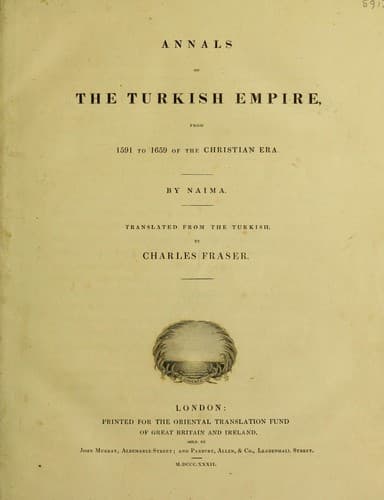
Annals of the Turkish Empire, from 1591 to 1659Naima, Mustafa
History
Annals of the Turkish Empire, from 1591 to 1659
Naima, Mustafa
Turkey -- History -- 1453-1683
Among the events which took place during this period, the following
is worthy of being remarked. There lived in Constantinople a certain
Jewess, who by means of an unlawful traffic acquired notoriety, and
was the means of seducing and corrupting several individuals of some
note. Her corrupt practices awakened the displeasure of the spáhís,
who raised a tumult, and prevailed upon the governor of the city,
Khalíl Páshá, to deliver her up, in order that the evil of which they
complained might be removed. The governor, who seemed to have some fear
of this wretch’s wickedness, and thinking it probable the queen-mother
might hear of her, ordered Kazánjí Zádeh, a Chávush báshí, to go and
demolish her dwelling. He did so; and not only caused her children to
be seized, but also hurried them and her away to the governor. They had
no sooner reached the stairs of the senate-house than the spáhís lost
all patience, drew their weapons, and murdered every one of them. Their
odious carcases were thrown out into the Meidán. But the perpetrators
did not stop here. They cut off the Jewess’ hands, the instruments of
bribery and corruption, and nailed them to the door of some of those
who had been involved in her crimes. The emperor, however, was much
offended at the shameless violence which the spáhís had exhibited,
and therefore removed Khalíl Páshá from his office for not having
restrained them. He appointed the eunuch Háfiz Páshá in his stead.
_Concerning Abulhelím._
This person, commonly called Karah Yázijí, or Scrivano, was one of the
principal actors in the rebellion which began to rage in the east.
Whilst the Moslem army was necessarily employed in repelling the
aggressions of the Hungarians and protecting its frontiers from the
inroads of these and other infidels, several insurrections broke out in
the east. Karah Yázijí, known by the name of Abdulhelím, the commander
of a cohort, headed a band of lawless and disaffected peasants, and
unfurled the standard of rebellion in the district of Rohá.
This same Yázijí was formerly beglerbeg of Ethiopia. Towards the close
of 1007, when Hasan Páshá was called on by the court of Constantinople
to give an account of his maladministration in Anatolia, the deputy of
Caramania, Mohammed Chávush, went with a thousand men to chastise him;
and after an hour or two’s fighting, dispersed Yázijí and his band of
rebels. Yázijí fled to Iconium.
When the government of Constantinople heard of these things, it
appointed Mohammed Páshá, the son of Sinán Páshá, and third vezír, to
the office of commander-in-chief of all the Asiatic troops; and he
immediately sailed for Alexandria.
Public-domain text, read in full here on John Shaqi.
Reviews
Reviews
No reviews yet
Be the first to share your thoughts on this work.
Elsewhere in the archive
Join the Discussion
Join the discussion
Sign in to leave a comment or review.
Sign InorCreate an account