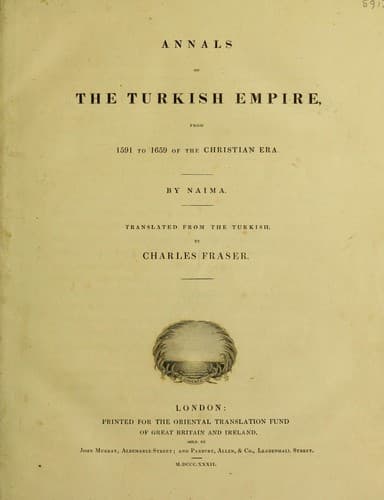
Annals of the Turkish Empire, from 1591 to 1659Naima, Mustafa
History
Annals of the Turkish Empire, from 1591 to 1659
Naima, Mustafa
Turkey -- History -- 1453-1683
In the meantime, however, Mahmúd Páshá, beglerbeg of Sivás, went to
Constantinople, and not only succeeded in obtaining a suspension of
hostilities against the wicked rebel, Karah Yazijí, but was himself, in
consequence of his representation, again received into favour. He made
it appear that his rebellion was owing to Mohammed Páshá’s tyranny,
and that it was on this account he had gone into the mountains. He, in
fact, represented him as a man worthy of important trust. The mufti
and the káímakám were so thoroughly persuaded of the truth of this
representation, that he was not only forgiven, but advanced to the
sanják of Chorum. When Mahmúd returned to Sivás, he and Karah Yazijí
were both employed in quelling the turbulence and insubordination which
existed throughout the country. The commander-in-chief, Mohammed Páshá,
was recalled. Hasan Beg Zádeh says that Chelebí Kází, the son of Siná
allah Effendí’s brother, had received large sums of money from Karah
Yazijí, and that he eagerly laboured by his representations, not only
to procure a pardon for Yazijí, but also obtained the sanják of Chorum
for him. He used his utmost efforts also to get Mohammed Páshá removed
from office.
_The state of Yemen._ (Arabia-felix.)
After the beglerbeg of Yemen, Hasan Páshá, had completely subdued, in
a series of battles, the rebels of that country who had raised the
standard of rebellion against the Ottoman government, the chief amongst
them, who appeared in the name of Imám Mehdí, and several other Arabs,
suffered death by decapitation; and the whole of his followers were
visited by retributive justice. The governor of Kokbán, Mohammed,
and the governor of Haja, Abd ur rahmán, having returned to their
obedience, afforded their aid to Sinán, the deputy, who was there left
to quell all disturbance, and things soon became quiet and settled.
_Ibrahím Páshá’s movements against Kaniza._
About the return of spring, and after the celebration of a religious
fast, which was about that time observed at Belgrade, the exalted
serdár, or commander-in-chief, pitched his camp in the plains of that
city, where he remained for the space of a month, making all the
necessary preparations for commencing a new campaign, and also to
afford time to the other troops to join the royal camp. Tarnákjí Aghá,
the ághá of the janissaries, the ághás of other regiments, and officers
of artillery, left the metropolis for Belgrade, about the commencement
of Dhu’l hijja of the last year, and reached the royal camp towards the
end of the same month. In consequence also of royal letters which had
been transmitted to his highness the khán of the Crimea, he furnished
a considerable supply of Tátár troops; and it was not long before
the serdár was informed that the troops which his royal highness
Ghází Gheráí, khán of the Crimea, had supplied, and which amounted to
several thousands, had arrived, under the command of a sultán, in the
neighbourhood of Belgrade.
EVENTS OF THE YEAR 1009, H.
Public-domain text, read in full here on John Shaqi.
Reviews
Reviews
No reviews yet
Be the first to share your thoughts on this work.
Elsewhere in the archive
Join the Discussion
Join the discussion
Sign in to leave a comment or review.
Sign InorCreate an account