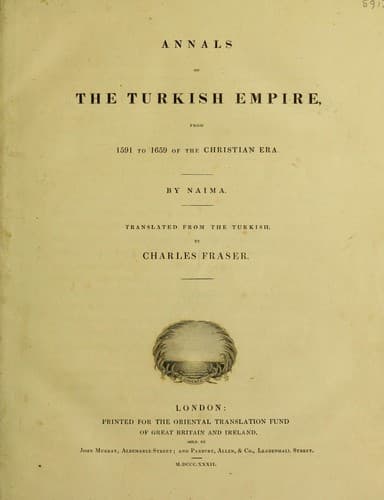
Annals of the Turkish Empire, from 1591 to 1659Naima, Mustafa
History
Annals of the Turkish Empire, from 1591 to 1659
Naima, Mustafa
Turkey -- History -- 1453-1683
All things being now in readiness, the grand army removed from the
plains of Belgrade, crossed the Save towards the end of Moharrem, and
encamped in the plains of Zimnún; whence boats loaded with provisions
were forthwith sent to Buda. On the grand army’s arrival at the seventh
stage of its journey, it was determined to march upon Usk, with the
view of reducing Osterghún.
It is necessary to observe, that the infidels of Kaniza (Canischa,
in Hungary) were in the habit of perpetrating murders and committing
robberies on both sides of the Drave and of the Danube, and, in short,
had become very proud and exceedingly troublesome. Persons either going
to, or coming from, the mills of Belgrade, were frequently attacked
or carried off. About this time, or a little before it, they burned
down to the ground a palanka called Púrnawar, not far from the bridge
on the Save, by which the Moslem grand army had crossed that river,
and committed some other devastations besides. Tarnákjí Hasan Páshá,
who had been removed from Buda, and who at this time lived at Petcheví,
no sooner heard of these cruelties than he immediately set out with a
party of his followers in pursuit of the incendiaries, and on coming
up to them on the banks of the Drave, they fled across a bridge, and
afterwards destroyed it. This did not save them; for Hasan Páshá and
his men crossed the river on rafts, again pursued the fugitives,
killed some of them, made others of them prisoners, and the remainder
of the vile incendiaries perished in the Drave, and so went to hell.
The páshá and his men, after having performed these praiseworthy
exploits, repaired with flying colours to the camp of the grand army,
carrying their prisoners along with them, and for which service the
serdár immediately granted the páshá his due meed of praise. He made
some enquiry of the captives relative to the condition and strength of
the enemy, to attack which the Moslem army had so far advanced.
The exalted serdár, in a council of his great officers, when the
subject concerning the reduction of Osterghún was adverted to, said:
“Behold, great preparations have been made, many difficulties have
been overcome, and just as we were on the eve of entering the enemy’s
territories, these infidels of Kaniza have destroyed the bridge by
which the Moslem army was to pass on its return. I am much concerned
on this account, and therefore think it of the utmost importance that
Búbofché, which is not far off, should be first reduced. This effected,
we shall be able to command the whole of this quarter by placing a
garrison in it, and, at the same time, keep the road to Buda open.” All
the military chiefs, princes, and ághás approved of this proposal, and
the serdár’s mind was bent on vanquishing Kaniza. Accordingly, Hasan
Páshá, after the above consultation, set his men in order, crossed the
bridge at Usk, and sent his heroes towards Búbofché.
Public-domain text, read in full here on John Shaqi.
Annals of the Turkish Empire, from 1591 to 1659 — John Shaqi
Reviews
Reviews
No reviews yet
Be the first to share your thoughts on this work.
Elsewhere in the archive
Join the Discussion
Join the discussion
Sign in to leave a comment or review.
Sign InorCreate an account