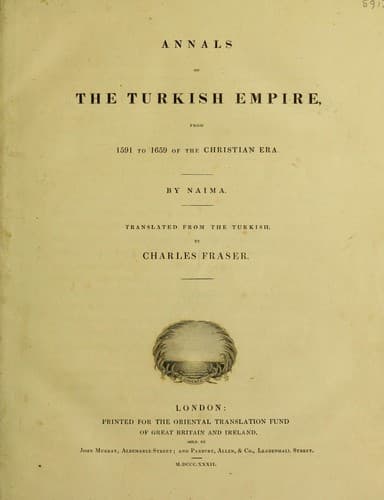
Annals of the Turkish Empire, from 1591 to 1659 — John Shaqi
Annals of the Turkish Empire, from 1591 to 1659Naima, Mustafa
History
Annals of the Turkish Empire, from 1591 to 1659
Naima, Mustafa
Turkey -- History -- 1453-1683
In the month of Jemadi I., Hasan Páshá again assembled his forces, a
considerable host: erected a bridge across the Koopa, in the vicinity
of Yení Hissár, and penetrated into the country of Croatia. The most
famous of the Croatian frontier chiefs, the governors of castles, the
Bani of Transylvania and the Croatian generals opposed him with a
mighty army, and gave him battle. The conflict was not long doubtful:
the Moslems were victorious; the infidel troops were broken, and
obliged to retreat. A great number of the fugitive host perished by the
edge of the sword: the whole of their fortifications, their stores,
six large cannon and other warlike apparatus fell into the hands of
the victorious Moslems. After having obtained this splendid victory,
the Páshá sent out parties to scour the country, who returned with an
immense number of captives and a great deal of spoil. Two thousand
heads, and two hundred living infidels were sent under guard of cannon
into the interior of the empire as trophies of the Moslem victors. A
proclamation was issued by the Páshá, that if ever the infidels should
again assemble such another host, they should meet with a similar or
severer fate; but it had no effect.
_News from the East._
The ungrateful Sháh of Persia marched this year, with a numerous army,
from Kazvín, in Irák, against Abdulmumin, Khán of Uzbek, and proceeded
as far as Khorassan. The Khán advanced to the borders of Jiorján to
meet the invading army; but finding his troops not sufficiently strong
to give the Sháh battle, he retreated to Nishapúr. The Sháh followed
him as far as Damghan, and after having reduced the cities of Sebzevár
and Isfaráyan in the district of Nishapúr, he returned victorious to
Kazvín.
_Concerning learned Men._
_Al Mevleví Mustafa ben Mohammed._—Mustafa ben Mohammed, one of the
most learned men of the age in which he lived, was born in the month
of Ramazán 940 of the Hijrah, when his father was cazí of Ipek, in
Romeili; and after having studied under the learned Kází Zádeh and
Sachlí Emír, he attended, in 963, Abúlsa’úd Effendí, and was appointed
head of an academy in 967, with a salary of twenty akchés attached to
his office. In ten years afterwards he was salaried by Alí Páshá. In
Shabán, A.H. 993, he fell into a lingering illness, which for some
time prevented him from active duty. In 998 he was so far recovered as
to be able to take upon himself the office of cazí of Tripoli. In the
month of Sefer of this year he was deposed, and soon afterwards died at
Aksheher, of a severe cold he had caught. He was much celebrated for
his great learning, and was a man of generous and mild dispositions. He
made a collection of all the common errors, and translated into Turkish
Kútb Mekín’s History of Yemen (Arabia Felix). He left behind him also
several poems in Turkish.
Public-domain text, read in full here on John Shaqi.
Reviews
Reviews
No reviews yet
Be the first to share your thoughts on this work.
Join the Discussion
Join the discussion
Sign in to leave a comment or review.
Sign InorCreate an account