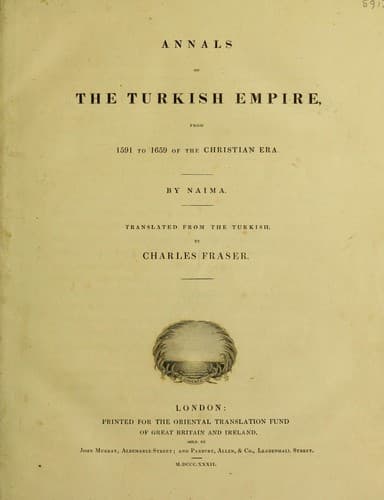
Annals of the Turkish Empire, from 1591 to 1659Naima, Mustafa
History
Annals of the Turkish Empire, from 1591 to 1659
Naima, Mustafa
Turkey -- History -- 1453-1683
It is but just to observe, what the warriors who were present in
the late wars knew to be true, that the orthodox armies were on two
occasions in very great straits, and had suffered much, _viz._ at Agria
(at Mehaj near Agria) and at Kaniza. On the first of these occasions
the orthodox troops had to contend with an army composed of soldiers
belonging to the seven kings (_i.e._ to all the European powers). The
second was at Kaniza, and which we have endeavoured to describe; but
which was much more disastrous to the orthodox troops, on the whole,
than the former. Seven successive days’ hard fighting, from morning
till evening, and in which the enemy maintained the superiority till
God himself inspired their powerful enemy with terror, when they all
fled, was of itself no easy task. Forty-three days, from first to last,
were also spent in the arduous undertaking of reducing Kaniza, which
was forced to capitulate only in consequence of the misfortune which
had happened to its powder magazine, and which left the place almost
a naked rock in the midst of a marsh. The troops also suffered greatly
from the want of provisions, and which could not be obtained even for
money. A wakáyet of salt could not be had for a dollar: so great was
the scarcity of all sorts of provisions on this memorable occasion.
The janissaries (who certainly do not appear to have deserved any
praise) were on the point of retiring altogether, and would not, most
assuredly, have remained in the camp another day, had not the fortunate
events which we have described above, taken place. Such were the
difficulties which the orthodox Moslem army had to encounter in these
wars.
Kaniza, after having been put into a state of thorough defence, was,
with its dependencies, put under the command of the beg of Kústandil,
Alája Eili Hasan Páshá, and its spiritual jurisdiction was conferred
on Kádurí Effendí. Twenty odás, with their officers, under the command
of Sefer Aghá, a Segbán báshí, were left to garrison it; besides three
thousand more who were to act in the capacity of spáhís. Sigetwar,
Petcheví, Shuklúsh, Usk, and Kaniza, were all put under the supreme
jurisdiction of the above-mentioned Hasan Páshá. To each of the plebian
troops two pieces of money were given, and they were all registered
among the troops of Buda and Agria. The serdár, on his return from
Kaniza, halted near Perzencha, where he ordered a new apalanka to be
erected. Having crossed the Drave near Yakúah, he passed on towards
Usk, where he permitted his army to disperse. The beglerbeg of Romeili,
with his provincials, was sent into winter-quarters at Perizrin; and
the beglerbeg of Anatolia, with his troops, were sent for a similar
purpose to Banialúka. The ághá of the janissaries was allowed to return
to Constantinople, and the victorious serdár himself returned to
Belgrade.
_Hájí Ibrahím Páshá defeated by Kara Yazijí_ (Scrivano).
Public-domain text, read in full here on John Shaqi.
Reviews
Reviews
No reviews yet
Be the first to share your thoughts on this work.
Elsewhere in the archive
Join the Discussion
Join the discussion
Sign in to leave a comment or review.
Sign InorCreate an account