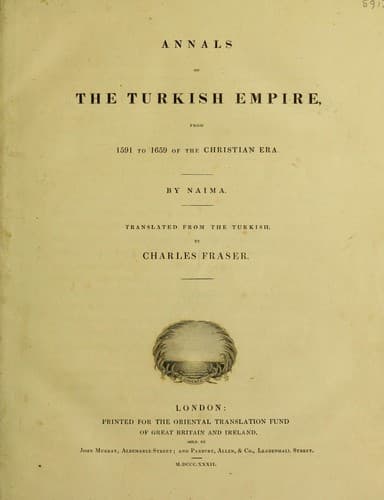
Annals of the Turkish Empire, from 1591 to 1659Naima, Mustafa
History
Annals of the Turkish Empire, from 1591 to 1659
Naima, Mustafa
Turkey -- History -- 1453-1683
We have already had occasion to notice the conduct of the notorious
rebel, Kara Yazijí, and how in consequence of intrigue and false
representation, he was appointed to the sanják of Chorum. In
consequence of this odious rebel’s having returned to his former
doings, Ibrahím Páshá was sent from Constantinople with communications
to Hájí Ibrahím Páshá, a vezír of the sixth rank, who was to
conduct an army against the rebel, and who also had been appointed
commander-in-chief in room of Hasan Páshá, who had been removed from
the government of Baghdád. In the event of Hasan Páshá’s prolonging
his stay at Baghdád, he was further instructed to proceed with the
Anatolian troops, and endeavour by every effort he could employ to
get the above-mentioned rebel and his brother, Delí Husein, into his
power. Hájí Ibrahím Páshá, accordingly, went with his army in search
of these men, and fell in with them at Cæsarea, at the head of twenty
thousand insurgents, where he offered them battle, and which they did
not decline accepting. The contest was severe and bloody, and Ibrahím
was finally obliged to seek his safety in retreat. The victorious
insurgents pursued him with an ardour worthy of a better cause, slew
fifteen officers, and more than one thousand janissaries in the
pursuit. It was with much difficulty that Ibrahím escaped into Cæsarea,
and those of his followers who had not been so successful, fell victims
to the fury of the insurgent army.
This event which we have here recorded is said, in some histories, to
have occurred in 1008 of the Hijrah; but most of them place it among
the events of the year we are now noticing, _i.e._ 1009. Besides, the
orders which government had issued respecting this infidel, and which
were sent to the inhabitants of Cæsarea, are dated on one of the first
ten days of Rabia II., 1009 of Hijrah.
The story concerning Gira, the Jewess and her children, before noticed,
is mentioned in the Fezliké of Hájí Khalífeh as having taken place last
year, but the author of the history we have followed in relating the
account, and Kara Chelebí Zádeh Azíz Effendí, place it where we have
placed it. One of the sons of this infamous Gira, however, embraced the
Moslem faith, and thus escaped the death which the whole of the rest
of his family suffered. He went under the name of Iksák (lame) Mustafa
Chávush. He died in the khán or inn of Devlet Sultání Ibrahím. The
whole of the effects of Gira were confiscated by the government, and it
is said they amounted to a very great sum. Her wares, independent of
her jewels and estates, were sold for more than five hundred _yúks_ of
money.
Public-domain text, read in full here on John Shaqi.
Reviews
Reviews
No reviews yet
Be the first to share your thoughts on this work.
Elsewhere in the archive
Join the Discussion
Join the discussion
Sign in to leave a comment or review.
Sign InorCreate an account