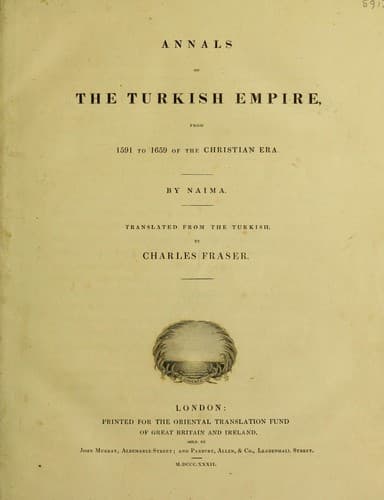
Annals of the Turkish Empire, from 1591 to 1659Naima, Mustafa
History
Annals of the Turkish Empire, from 1591 to 1659
Naima, Mustafa
Turkey -- History -- 1453-1683
The káímakám, or governor of Constantinople, Khalíl Páshá, on account
of some connivance he had with the Jewess whose tragic end we have
related, met with strong opposition from the spáhí tribe, and was
therefore removed from his high office, and was succeeded in it by
Khádem Háfiz Páshá, in the month of Shevál of this year; but who ten
days after was succeeded by Yemishjí Hasan Páshá. The reason for this
last change must now be explained.
During the time the Moslem army lay before Kaniza, Dimoo, the messenger
of the odious Michael, arrived at the Moslem camp with proposals to the
Ottoman government respecting the fortresses of Yanwah and Lipovah,
and was forwarded by the commander-in-chief to Constantinople; the
reïs-effendí was also sent along with him, bearing communications from
the commander in-chief.
The káímakám, Khádem Háfiz Páshá, remembering the stratagem which
Michael had practised on Háfiz Ahmed Páshá at Nicopolis, by means of
this said Dimoo, as before related, the anger of the Páshá was raised
to a high degree when he saw this messenger of deceit, and consulted
the mufti concerning him. The mufti gave it as his judgment that no
proposals whatever ought to be received from the odious Michael, nor
any agreement entered into with so infamous a wretch, who, along with
his deceitful ambassador, ought to suffer death. The káímakám, after
hearing the judgment of the high priest, and without further ceremony,
took summary vengeance on this satellite of mischief, by binding him to
a tree and punishing him according to the nature of his crimes. Besides
this act of summary justice exercised upon the person of Michael’s
messenger, and which was construed into an act of contempt manifested
towards the grand vezír and commander-in-chief, Ibrahím Páshá, who
had forwarded Dimoo to Constantinople, the káímakám, at the very time
Ibrahím was carrying on the siege of Kaniza, sent off a chávush with
orders to make inquiry about matters on the frontiers, without once
manifesting any regard to the authority of the commander-in-chief,
to whom all these affairs properly belonged. This instance of open
contempt awakened the displeasure of the grand vezír, which, no doubt,
was heightened by the conduct of the káímakám towards Dimoo, whom he
had sent to court, led him to seek revenge. The chávush he confined in
prison at Belgrade, and immediately wrote to the queen-mother, and to
the ághá of the sublime court, a statement of the káímakám’s conduct,
pointing out to them the evils that would result from the plan
pursued by Khádem Háfiz Páshá, both as it respected themselves and the
enemy. No messenger, he maintained, if such a method as the one above
described was to be pursued, would either come from the enemy to them,
or go from them to the enemy. In short, no consultation whatever, he
insisted, could be entered into, if the persons of messengers were not
to be respected. It was as much as to say, at least in the instance
Public-domain text, read in full here on John Shaqi.
Reviews
Reviews
No reviews yet
Be the first to share your thoughts on this work.
Elsewhere in the archive
Join the Discussion
Join the discussion
Sign in to leave a comment or review.
Sign InorCreate an account