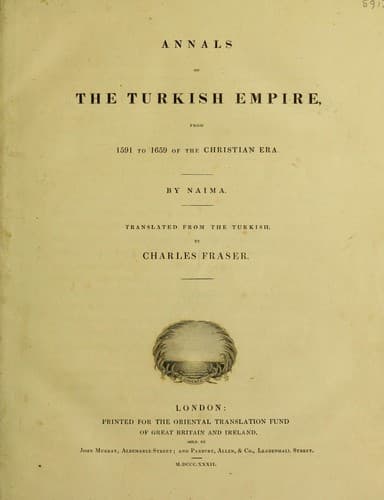
Annals of the Turkish Empire, from 1591 to 1659Naima, Mustafa
History
Annals of the Turkish Empire, from 1591 to 1659
Naima, Mustafa
Turkey -- History -- 1453-1683
_The grand vezír, Ibrahím Páshá’s death.—Yemishjí Hasan Páshá succeeds
him in the premiership._
We now begin to detail the events of another year; but before doing so
we have to mention that the grand vezír and commander-in-chief, Ibrahím
Páshá, having formed the project towards the end of the last year of
concluding a peace with the enemies of his country, deputed Murád Páshá
and Mohammed Ketkhodá to proceed to Osterghún, and there treat with
Ferdinand’s commissioners. A thousand Segbán troops, with coloured
feathers in their bonnets, under the command of the beg of Semendria,
accompanied the embassy.
Towards the end of Dhu’l hijja (the last month of the Mohammedan year),
the commander-in-chief pitched his tent in the plains of Zimrún,
opposite Belgrade, and watched with anxiety for the arrival of Alí
Aghá, brother-in-law to Ghaznafer, who succeeded to the ágháship of the
janissaries. Tarnákjí Hasan Páshá was appointed to the government of
Kaniza. It is said that Murád Páshá and Mohammed Ketkhodá went to Usk.
The Commander-in-chief’s strength was now weakened by disease, and the
signs of his mortality became quite apparent. In this condition he sent
for his uncle’s son, Morteza Páshá, and delivered over to him his most
important earthly concerns; and on the 9th of Moharrem (the first month
of the Mohammedan year) he departed this life, and his soul fled to the
Paradise above. Morteza Páshá and Etmekjí Zádeh, the defterdár, sealed
up the whole of his effects. The beglerbeg of Romeili, Mohammed Páshá,
by this time had left his winter-quarters and had come to Alája Hisár,
where he heard of the death of the commander-in-chief. This message was
brought to him in great haste, because the late serdár had appointed
him to take the command of the army in the event of his death. The
following day, after the usual washings were over, and the funeral
service performed, Mohammed Páshá consigned the remains of Ibrahím to
a tomb adjoining the mosque of Bairám Beg. The account of Ibrahím’s
death, and a statement of the affairs of the borders, were forthwith
dispatched to Constantinople, and laid before the foot of the throne
and before the members of the diván.
In the meantime Murád Páshá and Mohammed Ketkhodá, who had been
appointed to proceed to Osterghún with the view of negotiating a peace,
finished the building of a palanka at one end of the bridge of Usk,
which the late serdár had authorized to erect. They afterwards received
an order of government to remain at this palanka.
Some few days after the decease of the late serdár, the ághá of the
janissaries arrived at Belgrade, and immediately removed the remains of
Ibrahím to Constantinople, where they were interred in the temple of
Sháh Zádeh.
Public-domain text, read in full here on John Shaqi.
Reviews
Reviews
No reviews yet
Be the first to share your thoughts on this work.
Elsewhere in the archive
Join the Discussion
Join the discussion
Sign in to leave a comment or review.
Sign InorCreate an account