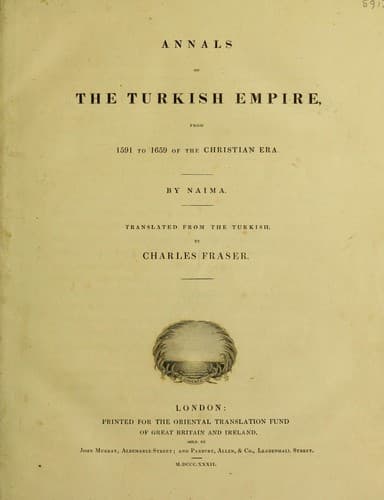
Annals of the Turkish Empire, from 1591 to 1659Naima, Mustafa
History
Annals of the Turkish Empire, from 1591 to 1659
Naima, Mustafa
Turkey -- History -- 1453-1683
According to one account, the news of Ibrahím’s death first reached
Constantinople about the 20th of Moharrem, when the seals were sent
to the káímakám, Yemishjí Hasan Páshá. After his advancement to the
premiership, he spent twenty days in preparing for his journey to
Belgrade. By some means or other he was allowed the tents, pavilions,
the equipage, the military arms, and, in short, the beasts of burden
which had belonged to his predecessor. He even married his relict, the
princess Ayesha.
The new grand vezír still postponed his journey to Belgrade, and at
length pretended it was too late in the season to proceed to that
quarter. “Nothing of importance,” he said, “could, by the time he
could arrive there, be accomplished.” He maintained, that no warlike
operation was immediately called for in the present circumstances
of the frontiers, or from the aspect presented by the enemy. Lála
Mohammed Páshá, who succeeded in the command after the death of
the late commander-in-chief, he further said, should be confirmed
in the serdárship, proceed, if necessary, with the force under his
command, and open the campaign. Thus did the new grand vezír excuse
his own tardiness, and try to dispense with the necessity of his
own departure. The Sheikh-ul-Islám, Siná-allah Effendí, thought
otherwise. He maintained it to be absolutely requisite that the new
grand vezír should proceed without a moment’s delay to Belgrade, and
urged this sentiment with great warmth even before the emperor. The
new grand vezír had no alternative left him but to proceed: but for
this interference of the high priest the grand vezír never ceased
to employ every stratagem he could against him, and at length had
him deposed. In the military and ecclesiastical departments he made
what changes he pleased: particularly in the first, and that too as
far as Adrianople; though this department properly belonged to the
Sheikh-ul-Islám Effendí. He advanced some, deposed others, as his
fancy directed, and some he degraded. The Sheikh-ul-Islám Effendí,
the high priest of the religion of Mohammed, felt his displeasure, as
well he might have anticipated, after having expressed himself in the
manner he did. Khoja Zádeh Mohammed Effendí was created mufti in the
room of Siná-allah Effendí. Bostán Zádeh Effendí and Shemish Effendí
were succeeded by Abdulhelím Effendí and by Isaád Effendí. The cazí
of Constantinople, Ketkhodá Mustafa Effendí, was replaced by Mustafa
Effendí of Adrianople, who was succeeded by Yahiah Effendí. The seventh
vezír, Khalíl Páshá, was made káímakám, and Háfiz Ahmed Páshá was made
third vezír. Tarnákjí, who had been deprived of his ágháship, but
afterwards appointed to the government of Baghdád, had to resign his
situation to Mohammed Páshá, son of Sinán Páshá, and Hasan Páshá was
made vezír at Constantinople. Hamza Effendí was made chancellor in room
of Okjí Zádeh. All these changes were effected by the new grand vezír.
Public-domain text, read in full here on John Shaqi.
Reviews
Reviews
No reviews yet
Be the first to share your thoughts on this work.
Elsewhere in the archive
Join the Discussion
Join the discussion
Sign in to leave a comment or review.
Sign InorCreate an account