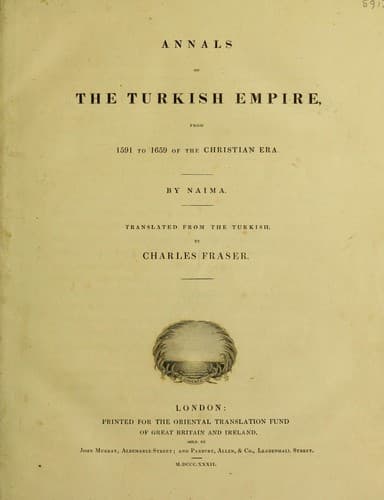
Annals of the Turkish Empire, from 1591 to 1659Naima, Mustafa
History
Annals of the Turkish Empire, from 1591 to 1659
Naima, Mustafa
Turkey -- History -- 1453-1683
next day, at all events, they would advance upon Kaniza: if the Turks
abandoned it, good and well; if not, we will lay siege to it. Let these
treacherous Hungarians (the inhabitants of Kaniza) see what will be the
fate of the fortress of Kaniza. After Kaniza is once disposed of, then
we shall take vengeance on them. They have every where instigated the
sword of the Ottoman to deeds of blood.”
On the 11th of Rabia II., about mid-day, this vile army of infidels,
with the beating of drums, sounding of cymbals, blowing of trumpets,
and ringing of bells, approached with great pomp, and with inverted
arms, the devoted city and fortress, and took up its position on the
banks of the river Berk, on the road which led to Vienna. A short time
after they had thus taken up their position, they perceived a number
of waggons which happened to be conveying provisions from Perzentcha
to Kaniza, but which the infatuated infidels thought were waggons come
to carry off the population of that city, and therefore gave orders
not to meddle with them in going in; determining to pursue them when
they again came out, and murder the whole of the people they might
find in them. They were, however, completely deceived. It is a curious
fact, but true, that the men who had escorted these waggons went to
the governor, after having safely entered Kaniza, and asked him what
was the meaning of the mighty army they had observed on the banks of
the Berk—for surely, said they, they are not enemies. The governor
pleasantly replied, that they had come on a visit: “but now that you
have all safely got into the fortress,” said he, “they shall be served
with a feast of red-hot melons without delay.”
The wisdom of the páshá in giving orders not to fire on the enemy, as
before observed, appeared most conspicuously to every one: for had he
ordered his guns to be fired at the enemy when they urged him to do so,
it is clear the waggons with provisions would certainly not have been
allowed to enter into Kaniza, but would in all probability have fallen
into the hands of the enemy, as well as the troops which escorted them.
But to return. The páshá called the heads of the artillery, and asked
them how many cannon there were in the place. Nearly one hundred, small
and great, was the answer. “Well then,” said the governor, “let them
all be charged, and as soon as you hear _Allah! Allah!_ discharge the
largest, and immediately afterwards, and at once, let the others be
discharged in the midst of the enemy.” The guns were accordingly loaded,
and the well-known signal waited for.
Public-domain text, read in full here on John Shaqi.
Reviews
Reviews
No reviews yet
Be the first to share your thoughts on this work.
Elsewhere in the archive
Join the Discussion
Join the discussion
Sign in to leave a comment or review.
Sign InorCreate an account