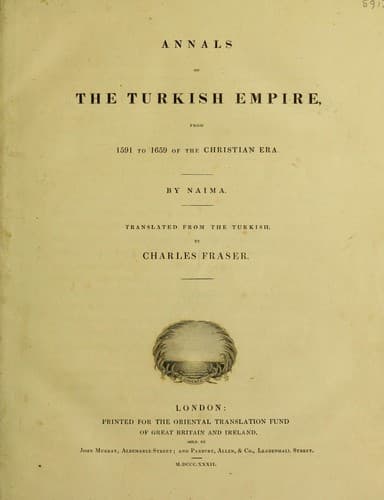
Annals of the Turkish Empire, from 1591 to 1659Naima, Mustafa
History
Annals of the Turkish Empire, from 1591 to 1659
Naima, Mustafa
Turkey -- History -- 1453-1683
The awful conflict we have just now endeavoured to delineate continued
with unremitting fury till midnight, when it pleased God to vouchsafe
his omnipotent aid to the besieged orthodox. At this moment the enemy
retreated to their fortifications, as if panic-struck, leaving behind
them eighteen thousand of their fellows, undistinguished and without
name. Among the wounded lay the brother of his holiness the Pope.
He was struck by a musket-ball, and soon afterwards perished. This
execrated wretch commanded thirty thousand troops.
After this remarkable success which had attended the Moslem arms, the
veterans approached the páshá, kissed his hand, and pronounced their
benedictions on his head. The wonderful páshá, on the other hand, was
all kindness, in return, for the honour shewn to him; and a thousand
expressions of praise and good wishes were uttered on this memorable
occasion.
When the eyes of the Moslems were opened to a clear view of the
advantages which God had afforded them, their hearts rejoiced. The awe
and terror with which the sight of so immense and desperate a host as
that which the enemy presented to their view sometimes inspired them,
now vanished completely from their minds. The heart of each of them
became firm and strong, like the tower of Alexander, and all of them
demanded to be allowed to assault the enemy in their turn.
After the victory had declared itself in favour of the orthodox
Moslems, as above described, Mathias and Ferdinand called their
princes, and held a council of war. “Although Kaniza was well supplied
with water,” it was said in the council, “the want of provisions,
however, would soon so press upon both its inhabitants and its garrison
as to force them to yield. If Turkish troops should happen to come to
their aid in their present circumstances, and we are able to beat them
off, then Kaniza would doubtless yield without further resistance. Let
us winter here,” continued the speaker, “but before the winter season
breaks let us send away our cannon.” The governor of Malta, Don Juan,
observed, “that if the cannon be removed, the Turks will rush forth,
and leave not a man of us alive upon the earth. Besides,” continued
he, “though those Turks stationed at Sigetwar may at present have no
intention of attacking us, they will, most assuredly, come and do
so, when they hear we have sent away our cannon. Without cannon, we
shall not be able to stand any time before them, and as to handling
the sword, we can have no chance whatever with them.” Such was the
manner in which this council of Austrian officers reasoned. They agreed
to continue the siege; they increased the number of their guns; they
erected a mound round Kaniza, and commenced firing at the rate of two
thousand balls per day. These did immense evil. The outer walls were
totally demolished. The houses were made level with the ground. But
the enthusiastic Moslems, such was their zeal, built up by night the
Public-domain text, read in full here on John Shaqi.
Reviews
Reviews
No reviews yet
Be the first to share your thoughts on this work.
Elsewhere in the archive
Join the Discussion
Join the discussion
Sign in to leave a comment or review.
Sign InorCreate an account