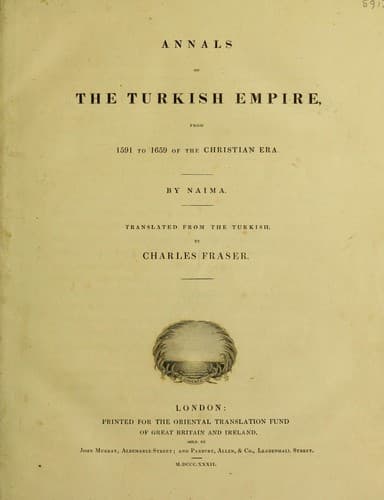
Annals of the Turkish Empire, from 1591 to 1659Naima, Mustafa
History
Annals of the Turkish Empire, from 1591 to 1659
Naima, Mustafa
Turkey -- History -- 1453-1683
trenches, slew nine hundred of them before they had time to escape, and
took one hundred and fifty prisoners, whom he sent into the fortress.
In these trenches he seized twelve pieces of ordnance, besides other
arms and ammunition.
Hasan Páshá despatched other five hundred men to the aid of Karah Omar,
who, after having received this augmentation of force, conveyed the
whole of the cannon and ammunition which fell into his hands into the
fortress.
Next morning Hasan Páshá, after having offered up his devotions, sat
down on the gate opposite to Sigetwar, took out two purses, the one
containing ducats, the other dollars, and scattered these pieces of
money among those of his men who had been the active agents in seizing
prisoners, or who had brought in several heads. Eighteen thousand
heads, it was conjectured, had thus been brought to him. The páshá,
without any unnecessary delay, sent off an account of their wonderful
good fortune to the commander-in-chief, and immediately mounting his
horse, rode to the enemy’s forsaken trenches, and encouraged and
praised his men. Only about six hundred remained in the fortress: the
rest were all employed either pursuing the fugitive army, or taking
possession of their trenches. Four times did Ferdinand try to rally his
forces and retake them; but Hasan Páshá, who was now master of them,
turned his own guns (about forty in number) against him. Those of the
enemy who had kept together made their way to Perzencha, where they
found some little time to reflect on what had befallen them. It was
now they perceived with some clearness the stratagem which the Turks
had so effectually laid for them. Again Ferdinand rallied his men,
and again attempted to retake his trenches; but Hasan Páshá directed
the guns of the fortress, as well as their own, which had been left
on the trenches, against them with such effect as again to repulse
them with immense slaughter. The field was literally covered with dead
bodies. More than thirty thousand heads were again collected, and laid
before the páshá. He desired his troops to carry on the pursuit with
vigour, and not to lose time in searching the enemy’s tents, as they
should find time enough for that afterwards. “The enemy, you see,” said
he, “are abandoning their tents as fast as they are able, but let us
try and surprize Ferdinand before he leaves his own.” Accordingly, a
field-piece was directed against it, but the ball, though it shattered
his tent to pieces, and killed a number who were near it, did himself
no injury. Ferdinand had now no alternative left him but flight.
Accordingly, he, and those who still remained faithful to him, mounted
their horses, but were every moment in terror lest the Turks should
intercept them and cut them off. In this terror they made to the ford
of Paulet, where Ferdinand experienced great difficulty in crossing
it, and where a hundred of his few remaining troops perished. Thus did
Public-domain text, read in full here on John Shaqi.
Reviews
Reviews
No reviews yet
Be the first to share your thoughts on this work.
Elsewhere in the archive
Join the Discussion
Join the discussion
Sign in to leave a comment or review.
Sign InorCreate an account