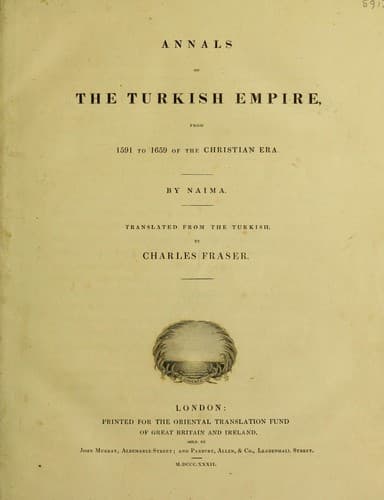
Annals of the Turkish Empire, from 1591 to 1659Naima, Mustafa
History
Annals of the Turkish Empire, from 1591 to 1659
Naima, Mustafa
Turkey -- History -- 1453-1683
Ferdinand leave the whole of his camp, his ordnance, his treasures, his
splendid furniture, and his glory behind him.
Hasan Páshá, after performing his afternoon’s devotions, called Meseli
Beg and Omar Beg, and ordered them to pursue the fugitives wherever
they could find traces of them, but prohibited their taking spoil till
the infidels were wholly rooted out, or completely dispersed. After
writing out a statement of the successes which had attended the Moslem
arms, he sent it off to the commander-in-chief, and then returned to
Kaniza.
On the following morning, after offering up his devotions as usual,
the páshá mounted his horse, rode to the camp, where he was cheered,
saluted, and had his hands kissed by his victorious troops, whom he,
in his turn, praised for their heroism and bravery. On entering into
Ferdinand’s tent, he perceived a lofty throne standing in the midst
of it, every where ornamented with silver and gold: its feet and top
were garnished and variegated with precious stones and other jewels;
a diamond was fixed in each of its supporters, each one of which was
equal in value to the revenue of Rúm (Europe or the Roman empire). On
each side of this throne were twelve chairs decked with crimson silk,
the borders of which were ornamented with pearls and other jewels. In
front of the throne was a table about six cubits in length, ornamented
and decorated like the former. In this pavilion of grandeur did the
pious Hasan Páshá perform his devotions, and returned thanks to God
for the victory with which their efforts had been crowned. With tears
in his eyes he acknowledged it as a favour from God, and as a sign of
their prophet’s benevolence, miraculously interposed in their behalf.
After having ended this oration, he drew his sword and split the throne
into pieces, sat down upon one of these, and his grandees and ághás,
according to their rank, sat down on the chairs which surrounded him.
He now again pronounced a long oration, and then wrote out a third
statement, giving an account of the patience, firmness, union, and
other excellent qualities of his men to the commander-in-chief. After
having finished his discourse, and had sent away the report to the
serdár, he asked who were the first who had entered into Ferdinand’s
pavilion. Three janissaries and four borderers presented themselves,
and said they were the first who had entered it. “Well then,” said
the noble-minded páshá, “with the exception of the tent itself, and
the arms that are in it, all the rest belongs to you.” As to the
rest of the tents, whether they belonged to Ferdinand or to others,
none of them were touched, but were strictly watched till such time
as the decision of the commander-in-chief could be obtained. The
forty-two pieces of cannon and five falconets which had been taken in
the trenches, were most beautifully ornamented by art, each being of
considerable value. They had the appearance of ingots of gold, and bore
Public-domain text, read in full here on John Shaqi.
Reviews
Reviews
No reviews yet
Be the first to share your thoughts on this work.
Elsewhere in the archive
Join the Discussion
Join the discussion
Sign in to leave a comment or review.
Sign InorCreate an account