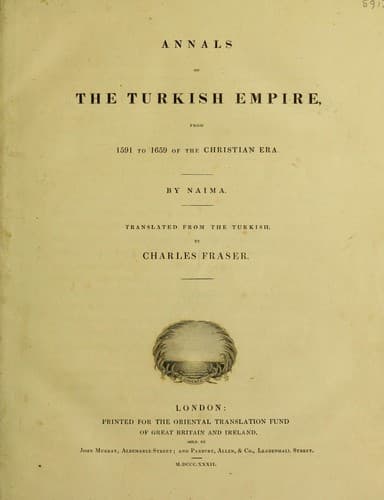
Annals of the Turkish Empire, from 1591 to 1659Naima, Mustafa
History
Annals of the Turkish Empire, from 1591 to 1659
Naima, Mustafa
Turkey -- History -- 1453-1683
Menlá Ahmed Effendí, about the end of the month Sefer, was deposed,
and Bostání Zádeh Mohammed Effendí was appointed to succeed him in the
jurisdiction of Romeili. On the 8th of Rabia I. the ambassador of the
Sháh of Persia, and on the 25th the governor of Gilán, Ahmed Khán,
reached Constantinople. The latter of these, Ahmed Khán, governor of
Gilán, having come with the view of imploring the protection of the
emperor, the great men of the state went forth with great pomp as he
was coming into the harbour to meet him. He was conducted to the palace
of Yúsuf Páshá, near Kirk-cheshmeh, where all the honours due to his
rank and office were shown him. But as it was on account of escaping
the molestations of Sháh Abbás he had taken refuge under the royal
shadow, he conceived that the royal favour bestowed on him was less
than what he had anticipated, and therefore, grieved and afflicted,
he requested to be allowed to go to Baghdád. His request was complied
with: a suitable salary was allowed him, and in the month of Rajab he
set out on his intended journey. Having many friends and adherents
in Shirván, however, he directed his steps thither with the view of
endeavouring to effect a change in his own favour, but had no sooner
reached the confines of Gunja than the governor of that place seized
his person for having dared to depart from the path which had been
assigned him, and put him in prison.
_The Spáhís create a disturbance in the Diván._
Whilst the new grand vezír, Síávúsh Páshá, was actively employed in the
duties of his office, a very serious disturbance took place. On the
23d of Rabia I. the pay of the troops was issued, when the Janissaries
received the full amount of what was due to them; but there not being
sufficient money to pay the Spáhís the whole of their salaries, they
became discontented, raised a great noise, assaulted the royal diván,
clamorously demanded the head of the high treasurer, Emír Páshá, who,
on account of his great wisdom and prudence, was much respected by
the emperor, and stoned their own ághás. The affair came before the
royal presence, who ordered forthwith an advance of a hundred yúks
(about 100,000 dollars) from the royal coffers, but the obstinate
soldiery would not accept of it, whilst they became more violent and
unruly. Three times did the chief of the royal messengers and the
superintendant of the household troops go forth to try to pacify them,
and to advise them to take their allowance. “Take your pay,” they said,
“and leave off your unreasonable demand with regard to the head of the
treasurer:” but this speech was replied to by a shower of stones. The
military judges now stepped forward, and with the same view said, “Your
pay has been advanced: the treasurer is a descendant of the Prophet:
how is it possible that you thirst for his blood, contrary to all law
and justice?” This had no effect. The military judges again advanced
with the royal letter, containing an exhortation to obedience, which
Public-domain text, read in full here on John Shaqi.
Reviews
Reviews
No reviews yet
Be the first to share your thoughts on this work.
Join the Discussion
Join the discussion
Sign in to leave a comment or review.
Sign InorCreate an account