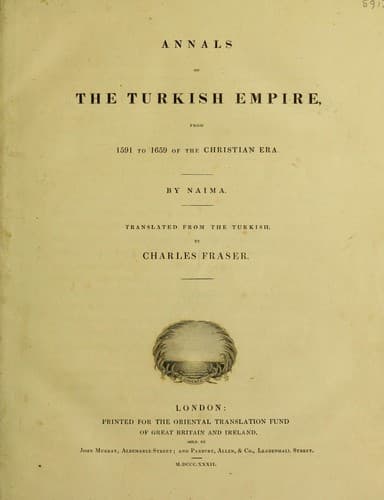
Annals of the Turkish Empire, from 1591 to 1659Naima, Mustafa
History
Annals of the Turkish Empire, from 1591 to 1659
Naima, Mustafa
Turkey -- History -- 1453-1683
During the space of fifteen days the Moslem camp before Pest
experienced the most dreadful hardships for want of provisions. One
kíleh (a measure) of flour sold for twenty pieces of gold, and one
of barley for fifteen, and when no more could be had for any price,
the troops were obliged to be supplied, though at the utmost risk,
from Buda. This was secretly accomplished by boats, which were sent
over from under the water-gate. The Budians, however, began to murmur,
and remonstrated against supplying them with an article which they
themselves might soon be in need of. All further supply of this kind
was, therefore, prohibited; but this prohibition was, notwithstanding,
found ineffectual. Some for the love of money sold provisions, and
others there were who sent a supply to their friends.
At length, Alí Páshá, the same who counselled the commander-in-chief
against leaving Buda when he went on his fruitless expedition into
Transylvania, Hábel Effendí, Alí Páshá’s coadjutor, and the ághá of the
janissaries, went to the serdár and told him plainly they would not
afford any further supply of provisions. “If you,” said they, “continue
ten days longer, all the provisions in Buda will be exhausted: send us,
therefore, Mohammed Páshá with a certain number of troops, and do you
go away altogether.” Mohammed Páshá seemed at first inclined to decline
this proposal, but afterwards said, that he had been two years already
in Buda, but that if he was ordered to remain another year in it he
would endeavour to do his duty. The Budians fell upon their knees and
begged him to accept of the office; they also petitioned the serdár
himself, and kissed his beard; so earnest were they that Mohammed Páshá
should remain with them. The serdár condescended to grant them their
request. One thousand men whose pay had been advanced, and one thousand
feudatory troops were appointed to Buda, besides military stores and
money. He also sent a robe of honour to Mohammed Páshá. After the hour
of the afternoon prayers, Yemishjí Hasan Páshá turned his face towards
his barks, moved away on foot, bidding adieu to scenes which reflected
no honour on his military skill, prudence, or courage.
Mohammed Páshá was a man of grave deportment, chaste manners, and an
officer of inflexible firmness and of great courage. When in the siege,
if any of his troops raised a commotion on account of the scarcity of
provisions, he used to beat them most soundly, and then reprove them
for their rashness. Not one, in fact, ever ventured to show him any
resistance, such was the influence he maintained amongst his troops.
After the serdár took his leave, the troops destined for Buda entered
that place at the water-gate under covert of the night: their ordnance
was also conveyed during the same period.
Public-domain text, read in full here on John Shaqi.
Reviews
Reviews
No reviews yet
Be the first to share your thoughts on this work.
Elsewhere in the archive
Join the Discussion
Join the discussion
Sign in to leave a comment or review.
Sign InorCreate an account