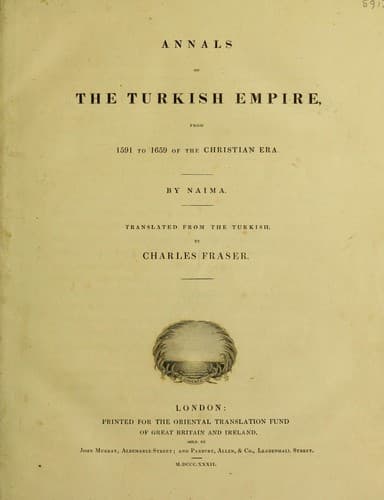
Annals of the Turkish Empire, from 1591 to 1659Naima, Mustafa
History
Annals of the Turkish Empire, from 1591 to 1659
Naima, Mustafa
Turkey -- History -- 1453-1683
Next day, the 1st of Rabia II., the commander-in-chief, Yemishjí Hasan
Páshá, passed through Keshkemet, and arrived at Waradin. Four large
cannon which he took with him were dragged along by his soldiers;
but he left two of them at Sonbúr, and the remaining two at Batchka.
Passing over the bridge at Waradin he pursued his journey towards
Belgrade.
In the meantime, Mohammed Páshá, after entering Buda, held a council
of his officers, to whom he delivered a comforting and encouraging
speech, and then dismissed them by telling them to go, every man, to
his respective post. Next morning, at daybreak, five hundred horsemen
were selected and sent out towards Awa, near which they dispersed two
pickets belonging to the enemy. Some of them they killed, and others
of them they made prisoners. The enemy, as before observed, had placed
a number of their cannon at Kiris Elias, and for the space of ten
successive days battered the walls and made several assaults, but they
were uniformly met and repulsed by showers of musketry, and the hurling
of bombs from the besieged. One day, when they thought they would carry
every thing before them by one general assault, the brave and orthodox
Moslems, as related in the Memoirs of Soleimán Páshá, rolled amongst
them a number of bombs charged with pieces of iron, which, when they
exploded, destroyed several thousands of the assailants, and completely
repulsed them. After this last, but very effectual check had been
given to them, they began to dig beneath the gate which looked towards
Vienna, with the view of laying mines, and in the most desperate manner
and with the utmost fury directed no less than two thousand cannon-shot
against the walls, by which means they at last effected a large
breach. The situation of the besieged was now truly perilous. But the
brave, heroic, and orthodox Moslems were determined to maintain their
resistance, or die in making that resistance. With this view, and in
the solemn hour of night, they entered into a sacred compact with each
other to devote themselves to death in defending Buda.
Public-domain text, read in full here on John Shaqi.
Reviews
Reviews
No reviews yet
Be the first to share your thoughts on this work.
Elsewhere in the archive
Join the Discussion
Join the discussion
Sign in to leave a comment or review.
Sign InorCreate an account