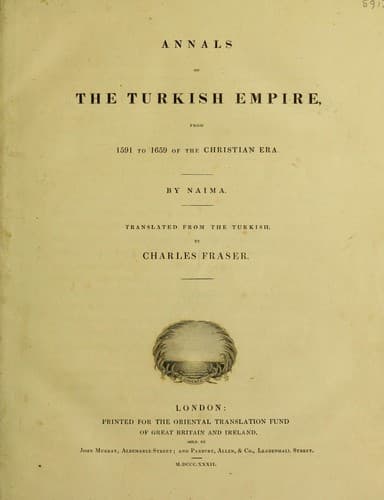
Annals of the Turkish Empire, from 1591 to 1659Naima, Mustafa
History
Annals of the Turkish Empire, from 1591 to 1659
Naima, Mustafa
Turkey -- History -- 1453-1683
On the 23d of Rajab the spáhí legion requested his majesty, the
emperor, to call a general diván for the purpose of taking into
consideration the state of the empire, every where torn and afflicted
with rebellion and insubordination. His majesty complied with this
requisition. Accordingly, the mufti, Siná-allah Effendí, the káímakám,
Mohammed Páshá, Siderín Akhí Zádeh, Abdul Míámin Mustafa Effendí,
and the ulemá, of all ranks, in all about thirty in number, met in
council. On the part of the spáhís, Hasan Khalífeh, Poiráz Osmán, and
the secretary Iksámí presented themselves before the royal diván and
spoke thus: “Sire, in consequence of the war which you find necessary
to carry on at a distance, the glory of the royal house is impaired,
and its dignity is diminished. The empire, from one end to the other,
is trampled upon. The government of Erzerúm is subjected to Gusah Nefer
Páshá’s soldiery and levends (a kind of volunteers); the government
of Sivás is under the oppressive rule of Ahmed Páshá; Caramania is in
the power of Delí Hasan; the sanjáks of Merzefún, of Kostamúní, and of
Kankarí, in like manner, are in the hands of the rebels Tevíl and Karah
Seyed. The insurgents and rebels have seized the whole world. Five or
six times a commander-in-chief has been appointed, but no good result
has followed; nothing has been accomplished.” After talking a great
deal in this manner, and pointing out the injustice and corruption
which had crept into the administration, they adverted to one or two
flagrant instances as proofs of their assertions. It was with great
difficulty that Sáa’tjí Hasan Páshá, who had been confined in the Seven
Towers, escaped undergoing the extreme sentence of the law on this
occasion. The fourth vezír, Tarnákjí Páshá, was also brought forth,
and would have undergone the sentence of death; but in consequence of
the intercession of the janissaries he was pardoned. The kapú ághá,
Ghaznafer Aghá, who had been the means of raising Khosrú Páshá and
Osmán Aghá, the ághá of the palace, who were afterwards presented,
were not so fortunate. The emperor, when all these transactions were
over, returned to the haram or seraglio, whilst the exclamations of the
people ascended to the very heavens in his behalf. The populace soon
after dispersed themselves.
_Yemishjí Hasan Páshá returns to Constantinople._
Soon after the grand vezír, Yemishjí Hasan Páshá, had dismissed
the khán of the Tátárs, to go into winter-quarters at Petcheví, he
delivered over to Lála Mohammed Páshá the whole of the affairs of the
frontiers. The magazines of provisions and other stores in Belgrade he
committed to Etmekjí Zádeh, the treasurer, and to Mohammed Páshá; and
appointed his own lieutenant, Mustafa Aghá, to collect provisions in
the districts of Bosnia and Buda.
Public-domain text, read in full here on John Shaqi.
Reviews
Reviews
No reviews yet
Be the first to share your thoughts on this work.
Elsewhere in the archive
Join the Discussion
Join the discussion
Sign in to leave a comment or review.
Sign InorCreate an account