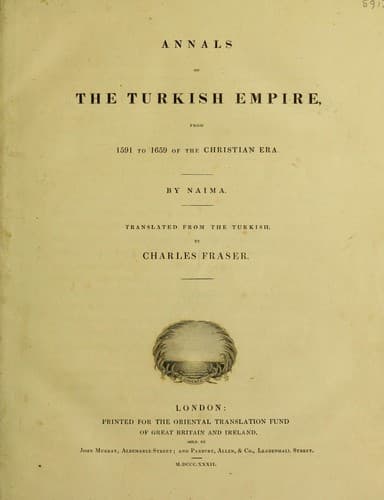
Annals of the Turkish Empire, from 1591 to 1659Naima, Mustafa
History
Annals of the Turkish Empire, from 1591 to 1659
Naima, Mustafa
Turkey -- History -- 1453-1683
Having heard of the late transactions in Constantinople which had
been occasioned by the spáhís, he imagined, and not without good
reasons, that he was in danger of losing his own life; he therefore
took a company of unemployed servants along with him, and set out for
Constantinople. On reaching Yaghodina he was met by Hasan Aghá, a
kapújí báshí, who informed him that Siná-allah Effendí, in compliance
with the wishes of the spáhís, had been created mufti. Another
messenger, called Yemenlí Hasan Aghá, a khetkhodá of the court, brought
him a letter, which stated that if he wished his own existence to be
continued, to make all the haste he possibly could. He recommenced his
journey immediately, but was considerably impeded in crossing the river
Múrov, owing to the masses of ice which floated upon its surface.
However, he got safely over it, and when he arrived at Nisa he met
another messenger, who brought him a letter apprizing him of the fate
of Ghaznafer, who suffered death along with Osmán. At a place called
Khurmán he was met by two other kapújí báshís, who brought him a royal
letter, and another from the queen-mother, both of which invited him
to court, and which also were sufficient tokens of their good-will. He
immediately returned a humble answer to these communications by the two
persons who brought them to him. On his reaching Adrianople he took up
his lodgings for a few hours in the house of Etmekjí Zádeh, his own
treasurer, who was then at Belgrade. Yahiah Effendí, who was afterwards
raised to the office of high priest, happening to be disengaged when
the grand vezír arrived, waited on him, and both together, about
seven o’clock in the evening, set out for the metropolis. On reaching
Selivría they were met by Yemenlí Hasan Aghá, a kapú ketkhodá, and Sárí
Alí Aghá, superintendant of the Soleimáníyeh, who strongly charged
them not to delay entering the palace that night, for if they did,
the messengers assured them the spáhís would next morning completely
prevent their doing so. The grand vezír immediately descended from
his chariot, mounted a swift charger, and reached the royal palace
about four o’clock in the afternoon on the 25th of the month Shabán.
The emperor received him most graciously, and welcomed his arrival in
the kindest manner. After the grand vezír had delivered a statement
to the emperor, of the affairs on the frontiers, he received a visit
from the káímakám, Mahmúd Páshá, who no sooner departed, than the two
military judges came to pay their respects to him also. When these
exalted prelates were about retiring, he desired them to go to the
mufti and give him his compliments; “Tell him,” said the grand vezír,
“that had it not been the night-season, I would have called on him
to pay him my respects in person at his own fortunate mansion; that
as I did not wish to disturb him at so unseasonable an hour of the
night, I have preferred waiting till tomorrow, when I shall not fail
to visit him.
Public-domain text, read in full here on John Shaqi.
Reviews
Reviews
No reviews yet
Be the first to share your thoughts on this work.
Elsewhere in the archive
Join the Discussion
Join the discussion
Sign in to leave a comment or review.
Sign InorCreate an account