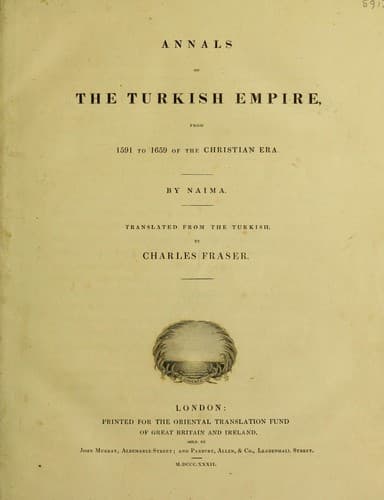
Annals of the Turkish Empire, from 1591 to 1659Naima, Mustafa
History
Annals of the Turkish Empire, from 1591 to 1659
Naima, Mustafa
Turkey -- History -- 1453-1683
But be sure,” continued he, “to come back and tell me
how he received your message.” The reverend prelates, however, did
not return. The morning arrived, and no word whatever from the mufti,
nor any account of the prelates. This presaged no good. He, however,
ascertained by some other means, that the principal actors in the late
tumult had gone that morning to the mufti, and complained to him in
the most violent manner against him. “This vezír,” said they, “has, by
his bad management, and want of skill in the command of the troops on
the frontiers, allowed the infidels to gain some important advantages
over the orthodox Moslems, and has thus tarnished the glory and pride
of the Osmánlís.” Having preferred this complaint, they insisted on the
mufti’s giving them a decree to take away his life. The mufti complied.
These accusers, after succeeding with the head of their religion,
hastened away to the governor, Mahmúd Páshá, to show it to him. In some
histories it is said that this decree was delivered to the soldiery by
Mahmúd when the grand vezír was about entering the city on his return
from Belgrade. However, to make the thing as sure as the accusers
could, they went to the two military judges, and asked them to tell
them if the instrument which the mufti had issued was legal, and if so,
to sign it; which after some little importunity they did.
_Mahmúd Páshá reports these proceedings to the Emperor, who refuses to
sanction the deed of the Muftí._
Mahmúd Páshá, the governor of Constantinople, wrote out a report of the
proceedings which were carrying on against the life of the grand vezír,
Yemishjí Hasan Páshá, enclosed in it the decree of the high-priest,
which had been confirmed by the signatures of the two military judges,
and sent it to the emperor. In this report the cunning governor assured
the grand sultán, that if he did interpose in behalf of his vezír
serious mischief would inevitably be the result. The emperor, after
receiving this document and its enclosures, caused it to be published
that Mahmúd Páshá had stipulated with the heads of the disaffected to
give them thirty thousand ducats, and that he, in the event of grace
being shown to Yemishjí, had instructed them to raise a tremendous
tumult. This was a sufficient answer to Mahmúd’s report. The emperor,
moreover, declared that he had perfect knowledge of the whole of
his vezír’s conduct, and that if it had appeared that he had acted
unworthily of his high station, he, the emperor, knew how to punish
him. He was much displeased with the interference which had been made.
Public-domain text, read in full here on John Shaqi.
Reviews
Reviews
No reviews yet
Be the first to share your thoughts on this work.
Elsewhere in the archive
Join the Discussion
Join the discussion
Sign in to leave a comment or review.
Sign InorCreate an account