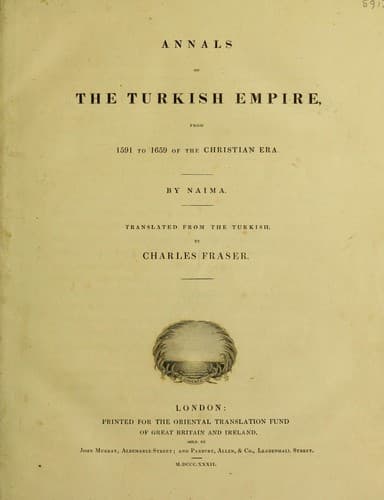
Annals of the Turkish Empire, from 1591 to 1659Naima, Mustafa
History
Annals of the Turkish Empire, from 1591 to 1659
Naima, Mustafa
Turkey -- History -- 1453-1683
The poor grand vezír and commander-in-chief felt the insecurity of
their situation, and being haunted by the horrors of a cruel and
untimely death, which his imagination pictured to him, he, at the
hour when every true Muselman was offering up his nightly devotions,
issued from his palace in disguised garments, accompanied by only two
faithful servants, and proceeded to the palace of the ághá of the
janissaries, called “the Palace of delight.” Here he was visited by
Yemenlí Aghá and Sárí Alí Aghá who desired him to take his ink-stand
and a few sheets of paper and to proceed without delay to the ághá
of the palace. The unfortunate vezír mounted a horse and went as he
was directed. On reaching the palace and entering into the hall of
audience, he there saw Hasan Páshá and the ághá of the janissaries with
his suite busily engaged in some affairs. The latter called the vezír
to advance, and directed him to draw out the following statement:—“That
the present acting mufti, Siná-allah Effendí, had been guilty of
affording countenance and protection to some of the insurgents; that
his brother’s son, Chelebí Kází, had, in a most unrighteous manner,
accepted of thirty thousand dollars from the rebel Scrivano; that he
had caused Mohammed Páshá, son of Sinán Páshá, to be deposed; that he
had joined with the multitude of spáhís in intimidating the diván;
that he had caused the ághá of the palace and the kizlar ághá (or ághá
of the seraglio) to be beheaded; that he had thrown the whole of the
community into a state of excitement by his murderous persecution of
the grand vezír; in short, that he was the moving cause of all the
disturbance, insubordination, rebellion and violence, which had lately
taken place in the city. Further: that the whole of the janissaries
were thoroughly convinced that this high-priest should be turned out of
his office, as a preliminary to the settling of those commotions which
agitated the public mind; that he should be banished to the island of
Rhodes, and his place filled by a man possessed of piety and orthodox
principles; that Mustafa Effendí, military judge of Anatolia, should
be the person to succeed him in his high office, because he was a man
possessed of piety and religion, and was, moreover, continent and
abstemious.”
Such were the contents of the statement above alluded to, and which the
grand vezír, when written out, wrapped up in a cloth and kept till the
proper moment for presenting it should arrive. His friends also sent
intimation, similar to what the statement contained, to the vezírs,
ulemá, armour-bearers, heads of the artillery, and to all the principal
persons in the community who were able to read; and all the faithful
subjects of his majesty were called upon to assemble under arms at
the mosque of Soleimán, and there wait to hear a declaration of his
majesty’s will and pleasure.
Public-domain text, read in full here on John Shaqi.
Reviews
Reviews
No reviews yet
Be the first to share your thoughts on this work.
Elsewhere in the archive
Join the Discussion
Join the discussion
Sign in to leave a comment or review.
Sign InorCreate an account