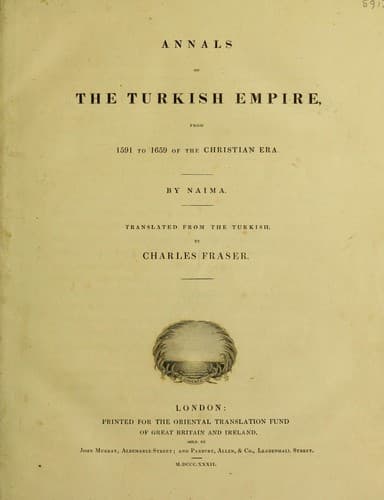
Annals of the Turkish Empire, from 1591 to 1659Naima, Mustafa
History
Annals of the Turkish Empire, from 1591 to 1659
Naima, Mustafa
Turkey -- History -- 1453-1683
The paper containing the accusations against the mufti was sent by
night, by a trustworthy person, to the sultán in his own private
apartments. The morning arrived, and the multitude began to assemble in
the vicinity of the Soleimáníyeh. The whole of the janissaries stood
fully accoutred under arms at the foot of the stairs opposite their
own barracks, and all strangers were ordered to withdraw. Hasan Páshá
and Ferhád Aghá, the ághá of the janissaries, stood forward on the top
of the stairs above-mentioned, produced a royal letter which one of
them read in the hearing of the janissaries. This royal letter assured
them of his majesty’s good opinion of them, and said that they did and
ever should participate of his grace and favour. “From the days of my
august and noble ancestors until this day,” it was more particularly
stated in this royal document, “you have always conducted yourselves
with propriety, and have never been guilty of any irregularity or
insubordination. You have uniformly obeyed my royal injunctions with
the utmost zeal and precision; and now I request you to aid my grand
vezír in chastising those unruly persons who have been the cause of
exciting turbulence and commotion in our royal city.”
The janissaries who had been instructed how to act their part in
this matter replied, after having pronounced many blessings on their
sovereign’s head, that they had some certain reasonable things to
advance, and begged they might be laid before the august throne. “The
muftis of former days,” they said, “used to be very much attached to
the royal house, but the present one, Siná-allah Effendí, was a traitor
to the true interests of the Ottomans. He has been bribed by Scrivano,
through his nephew, Chelebí Kází, with a sum of thirty thousand
dollars; he has deposed Mohammed Páshá, son of Sinán Páshá; he joined
the turbulent multitude who lately intimidated the diván, causing
some of its principal members to be executed; and at this moment he
is exciting the mob to be satisfied with nothing less than the grand
vezír’s life, having even issued a decree for this purpose. It is
our opinion,” continued the janissaries, “that he should be forthwith
chastised, and that Mahmúd Páshá, his chief coadjutor in this tumult,
should be executed without delay; that the turbulent and seditious
among the spáhí mob should be delivered up, and in the event of this
being declined, to visit the whole tribe with summary vengeance. If
they show a disposition to resist, then let them stand prepared for
combat, for we are ready to meet them.”
The grand vezír expressed his satisfaction, came forward along with
the ághá to their view, and sat down. The vezírs ulemá, and other
dignitaries and nobles also assembled. Sinán Páshá, son of Jeghala,
declined attending, but a messenger who was sent after him forced him
to comply whether he would or not.
Public-domain text, read in full here on John Shaqi.
Reviews
Reviews
No reviews yet
Be the first to share your thoughts on this work.
Elsewhere in the archive
Join the Discussion
Join the discussion
Sign in to leave a comment or review.
Sign InorCreate an account