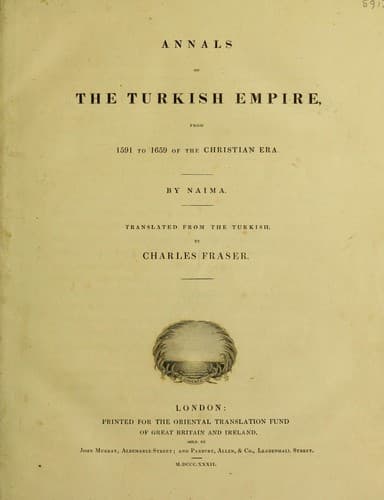
Annals of the Turkish Empire, from 1591 to 1659Naima, Mustafa
History
Annals of the Turkish Empire, from 1591 to 1659
Naima, Mustafa
Turkey -- History -- 1453-1683
The grand vezír again addressed the lieutenants of the ághás who had
brought him the resolution of the turbulent spáhís, and desired them to
return and inform them of the judgment of the new mufti; then to come
back to him, bringing along with them the proscribed persons, provided
they gave them up. “If they do not deliver them up,” said he, “then
inform them that the whole tribe of spáhís shall be entirely cut off
from serving any longer in the state, and their privileges be done away
with.” They were, moreover, to be informed, that the emperor expected
immediate obedience; that if they did not at once show signs of regret
by availing themselves of the overture made to them, he had determined
to take summary vengeance on them all; that their heads would be cut
off at the bottom of the stairs on which he, the grand vezír, stood.
The officers proceeded with their message, and delivered it in due form.
In the meantime, however, the grand vezír called one Devlet Aghá, a
kapújí báshí (who was in an after reign grand vezír), and desired him
to take forty of the household troops and proceed to the house of
Siná-allah, the mufti effendí, seize his person, put him on board a
vessel, and banish him to the island of Rhodes. Devlet Aghá proceeded
with his party to seize the person of the high priest, as directed, but
before he had reached his house the reverend father had fled and hid
himself.
Devlet Aghá not finding the object of his pursuit, called Hamza Aghá,
a kapújí báshí, and Murád Effendí, the second recorder, and desired
them to proceed and seal up the palace of the fugitive, Mahmúd Páshá,
sometimes called Gúzelcheh Mahmúd Páshá. At the same time persons were
sent to shut the gates of Constantinople, and to watch them. These
proceedings were announced in the At-maidán to the assembled spáhís,
who became so terrified that they all dispersed in the greatest dismay.
The ághá of the janissaries mounted his horse, and conducting his
troops through the streets of the city, soon restored peace and order
in all quarters of Constantinople. The great men and vezírs returned
to their respective mansions. Ferhád, the ághá of the janissaries,
no sooner restored order in the city than he went in pursuit of the
rebels. The grand vezír spent the remainder of that day in the house
of the ághá of the palace; and Ferhád, on proceeding to a barrack
belonging to the spáhís situate near the arsenal, immediately ransacked
it of every thing valuable, and slew a number of this turbulent
tribe. This circumstance laid a foundation of enmity between these
two powerful bodies, _viz._ the janissaries and spáhís. The barring
and locking of the gates of Constantinople proved also a great
inconvenience to the inhabitants, inasmuch as they were prevented from
burying their dead in the usual way.
Such, for a whole day and night, was the agitated state of the city,
occasioned by the events we have related.
_Poiráz Osmán and other rebels executed._
Public-domain text, read in full here on John Shaqi.
Reviews
Reviews
No reviews yet
Be the first to share your thoughts on this work.
Elsewhere in the archive
Join the Discussion
Join the discussion
Sign in to leave a comment or review.
Sign InorCreate an account