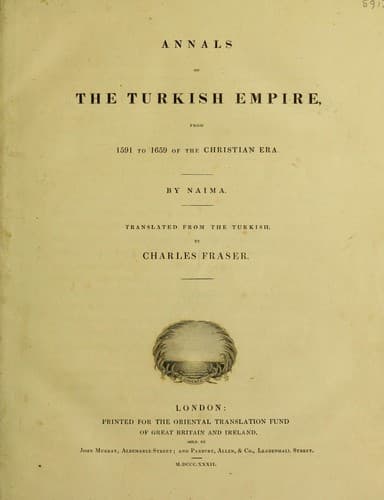
Annals of the Turkish Empire, from 1591 to 1659Naima, Mustafa
History
Annals of the Turkish Empire, from 1591 to 1659
Naima, Mustafa
Turkey -- History -- 1453-1683
The following day, at an early hour, the mufti, the vezírs, the
grandees, the ulemá, and others, met for consultation in the house of
the ághá of the palace, and continued their deliberations in reference
to the interests of religion and the benefit of the state till the
hour of prayer. The grand vezír then mounted his horse and went to
pay a visit to his august majesty, accompanied by the new mufti and
the military judge of Anatolia, Mustafa Effendí, who, it will be
remembered, was recommended by the janissaries to fill the office of
the high priest. The grand vezír was preceded by a body of armed foot
soldiers to the imperial palace, and after having had the honour of
kissing his sovereign’s hand, the emperor entered into conversation
with him and the other august persons that accompanied him about
the state of public affairs. The serdár, after the above interview,
returned in great pomp to the At-maidán, where the janissaries, who
had met there by appointment, fired several rounds, and the cavalry
went through their evolutions in token of joy for the success which had
attended the grand vezír.
The mufti and the military judge, after having conversed some little
while with the grand vezír, retired to their own homes.
Now that peace and good order had been established, the inhabitants
came forward in multitudes to congratulate the grand vezír on his
escape from the snares which had been laid for him, and to express
their gratitude for his having quenched the fury of the spáhís. On
this same day, in the afternoon, two messengers, one after the other,
arrived, and informed the vezír that Poiráz Osmán and Ohgúz Mohammed,
two of the principal leaders in the late disturbance, had been seized,
and that Mustafa Aghá, the ághá of the spáhís, was conducting these
two culprits into his presence. In a short time they appeared bound in
chains before him: the vezír addressed them thus: “Osmán Beg, I showed
you much respect and attention in the late war on the frontiers; I
conferred on you offices of trust and profit, and have heaped favours
upon you. Is this, then, the return you make? Is this according to
your solemn promises? What can be the reason that you have acted thus?
Why have you joined yourself to my enemies?” Poiráz Osmán replied;
“O, exalted páshá, why do you force me to speak? I certainly did not
commit the evil you impute to me in order that I should afterwards
offer an apology. What has happened to me has been my lot. I have not
trampled on your goodness so as to banish from my view all thoughts of
providence. I feel that I am every way worthy of punishment; at the
same time I humbly request you, in the exercise of your consummate
benevolence, not to allow me, a guilty man, to be strangled like a
woman, but kill me yourself with your sword.” “God forbid,” said the
vezír in return, “that we should kill a heroic man of your stamp,
especially as we know you must have been disadvantageously placed.
Public-domain text, read in full here on John Shaqi.
Reviews
Reviews
No reviews yet
Be the first to share your thoughts on this work.
Elsewhere in the archive
Join the Discussion
Join the discussion
Sign in to leave a comment or review.
Sign InorCreate an account