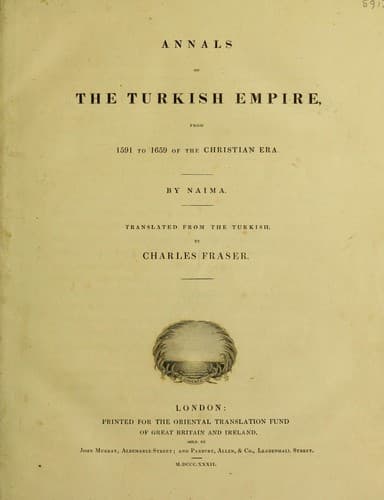
Annals of the Turkish Empire, from 1591 to 1659Naima, Mustafa
History
Annals of the Turkish Empire, from 1591 to 1659
Naima, Mustafa
Turkey -- History -- 1453-1683
His servants, falling in love with his money, however, took the
opportunity, when they reached a mountainous part of the country, to
murder him, and took the whole of his gold to themselves. Whilst these
wretches were disputing and maliciously contending as to the mode of
dividing their spoil, one of their number fled from them; and thus the
story of Kátib Jezámí was made known.
Hasan Khalífeh, another of the heads of the insurgents who had been
previously involved in other desperate acts, thinking himself perfectly
secure, entered into coffee-houses, and spent part of the nights of
the month of Ramazán in gay conversation, and in the participation of
good cheer along with some of his friends in the above houses; but on
the 11th night of that month, whilst enjoying his pleasure in one of
these cafés, he was seized and hurried away into the presence of the
emperor, when he was without mercy instantly sent to the mansions of
the dead. In this way the whole of the ringleaders of the insurgents
were disposed of: the world was thus delivered from their mischievous
existence.
As to Gúzelcheh Mohammed Páshá, the deputy-governor of Constantinople,
he fled and hid himself at the very commencement of the tumult, as
before observed; but he was afterwards discovered in the habit of a
súfí, near the mosque built by Hájí Khosrú, a rich man, on the outside
of Constantinople. He threw himself on the mercy of the sublime Sultán,
and thus escaped with his life.
New troubles, however, arose. A foundation for enmity between the
spáhís and the janissaries was laid by the proceedings of the grand
vezír, as before hinted. Peace and order had scarcely begun to be
felt, when a dispute arose between these two powerful military bodies,
and was carried on with the utmost asperity. Whenever any of the one
party met any of the other, a battle uniformly took place. But it
was beyond the walls of Constantinople that this hostility was most
fiercely manifested. The proud vezír’s passion for murder and bloodshed
continued unabated: his thirst for vengeance against the remaining
objects of his hatred he never failed to satiate whenever he found an
opportunity of doing so. He thought that the measure he had employed
in crushing the rebellion which had been raised against himself had
been completely effectual. He was proud of his own doings, and began
to publish abroad in the palace of the emperor Alexander (the court
of Constantinople) his own mighty deeds; and supposed he was every
way such a favourite with the emperor that nothing he could ask would
be refused. In this exalted state of his imagination, he passed five
successive inglorious fast days in the greatest transports and joy.
Having fully acquired the victory and glory which he thought necessary
for himself, he began to increase his own abstemiousness and piety in
a corresponding measure; but his fury and malignity for promoting the
purposes of his own heart were in proportion to the good qualities he
Public-domain text, read in full here on John Shaqi.
Reviews
Reviews
No reviews yet
Be the first to share your thoughts on this work.
Elsewhere in the archive
Join the Discussion
Join the discussion
Sign in to leave a comment or review.
Sign InorCreate an account