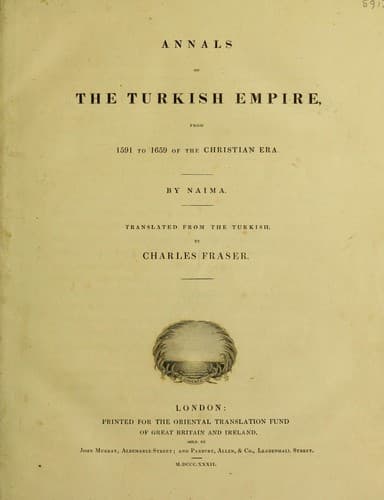
Annals of the Turkish Empire, from 1591 to 1659Naima, Mustafa
History
Annals of the Turkish Empire, from 1591 to 1659
Naima, Mustafa
Turkey -- History -- 1453-1683
But what,” continued the páshá, “induced you to adopt the course you
have taken? I wish you to give me an explanation;” and then urged
him to do so. Osmán Beg replied, “When I came to Constantinople, I
perceived the spáhís going on with their mischievous purposes, but
at first declined taking any share in them. Kátib Jezámí and others
came running about me; and when I tried to escape them they followed
me, urging me to join them. They used to tell me this and that; that
the mufti, all the vezírs, the military judge, and other great men
were in the plot; that they should without doubt accomplish their
purpose; ‘your making yourself singular,’ they said, ‘will not retard
the execution of our plan, and your obstinacy will only serve to bring
evil upon yourself.’ They took me one day to the mufti’s deputy, who
invited me to a splendid feast; I assembled that day with the rebels,
but did not, for a while, mix with them; I was afterwards invited by
Mahmúd Páshá to wait on him. I did so, and he constrained me to declare
my sentiments; to say on what side I was. ‘Osmán,’ said Mahmúd, ‘we
have concocted this great measure, and your not taking a decided share
in it is not wise; and to oppose the general voice, you know, is not
safe, especially as the conspirators have thirty thousand ducats at
their disposal. Do not, my friend, make yourself obnoxious;’ and much
more to the same purpose. From Mahmúd’s I was conducted to the mufti
effendí, Siná-allah himself, and thence to the military judge. Each of
the spiritual dignitaries employed many arguments to induce me to join
them. I was at last, from what I had seen and heard, persuaded that
all the men of name and power had espoused this unfortunate party’s
interest, and were united in carrying it forward to a conclusion. The
thirty thousand ducats were every now and then referred to. To make
the story short, the devil tempted me; I became one of their number,
and was one of the most active in the whole of the disturbance and
insubordination which have lately manifested themselves.” This seems a
very candid confession, but it helped the unfortunate culprit nothing.
The grand vezír looked in the poor devil’s face with astonishment,
and wondered at his statement. He ordered Aghá Mustafa to conduct the
culprits into the royal presence, where the whole of the above facts
were again elicited, and the result was, that the emperor ordered
their heads to be severed from their bodies, which was immediately
complied with. A day or two afterwards the insurgent Dipa kiz Rizván
met with a similar fate; so did also Ghuzáz Alí and Burnáz Mohammed;
but the infamous and wicked Kátib Jezámí could nowhere be found.
Strict search for him it must, however, be confessed, was not made. It
appears that he had collected a great quantity of gold together, had
himself put into a coffin, and was carried over from Constantinople to
Uskudár (Scutari), whence, with a few servants, he fled on horseback.
Public-domain text, read in full here on John Shaqi.
Reviews
Reviews
No reviews yet
Be the first to share your thoughts on this work.
Elsewhere in the archive
Join the Discussion
Join the discussion
Sign in to leave a comment or review.
Sign InorCreate an account