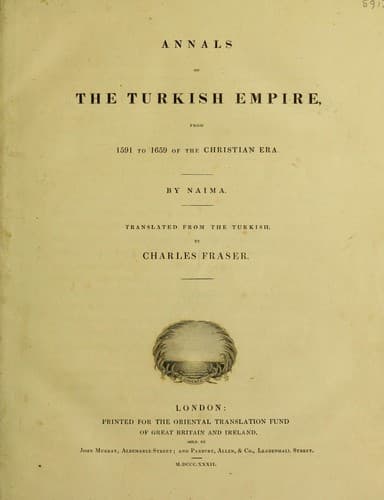
Annals of the Turkish Empire, from 1591 to 1659Naima, Mustafa
History
Annals of the Turkish Empire, from 1591 to 1659
Naima, Mustafa
Turkey -- History -- 1453-1683
fell into the hands of the Kizlar Aghá, who informed the emperor of
what was going on. The prince was first seized, then his mother, the
sheikh or doctor, and all the other persons who were any away connected
with the secret. This conduct, on the part of the persons concerned,
awakened, as well it might, the suspicion of the emperor, who deemed
it of so serious nature, that at the end of one month after they had
been apprehended they were made to feel what they had every reason to
dread. Mahmúd was a youth of great bravery and heroism. When at any
time he saw his father in a thoughtful mood about the issue of the
rebellion, which we have lately described, he used to say to him: “Make
me commander-in-chief, and I will soon bring these rebels to submit,
either by the sword or by acts of kindness: the thing is by no means
difficult.” The emperor, however, did not like to hear him express
himself in that way, and therefore prohibited the use of such language.
Among the strange events of this year is the following. Abd-ur-rahmán,
sometimes called Nedázlí, a teacher in an academy in Constantinople,
was apprehended on the 10th Jamadi II., and put to death in the
royal diván on a charge of impiety and atheism. Akhí Zádeh Effendí
the chief-priest of Romeili, and Asa’d Effendí the chief-priest
of Anatolia, were the two judges who condemned the unhappy man.
Asa’d Effendí, in a letter he sent to Tarnákjí Hasan Páshá, says
“he had never met in all his life such another Zendik (sadducee) as
Abd-ur-rahmán. He avowed most thoroughly,” continues Asa’d Effendí,
“his disbelief of the resurrection, heaven and hell, reward and
punishment. I asked him to reply to several texts, and employed many
strong and perspicuous arguments with the view of rescuing him from his
unbelief and depravity, but he would not recant. So great an unbeliever
was he, in his perverted judgment on points on which there can be no
doubt! But neither was he to be considered as an insane person, for
he argued strongly for his own views and mode of belief. There is
no hope whatever of convincing a madman; and this sadducee, when he
was not brought to repentance, deserved to die, and to this doom he
was subjected. If your excellency had been here you would, with your
own hands, have slain him. The world is delivered from his corrupt
opinions, Muselmans from his influence, and the orthodox faith from the
slanders of his tongue.”
_Concerning the operations of the new Commander-in-chief Mohammed
Páshá._
Soon after the grand vezír’s return to Constantinople last year, Lálá
Mohammed Páshá, whom he had left in the supreme command at Buda, was
appointed serdár in his room, or commander-in-chief of the whole of the
Turkish forces on the frontiers.
Public-domain text, read in full here on John Shaqi.
Reviews
Reviews
No reviews yet
Be the first to share your thoughts on this work.
Elsewhere in the archive
Join the Discussion
Join the discussion
Sign in to leave a comment or review.
Sign InorCreate an account